On this page
Can You Copyright AI Art? The Short Answer
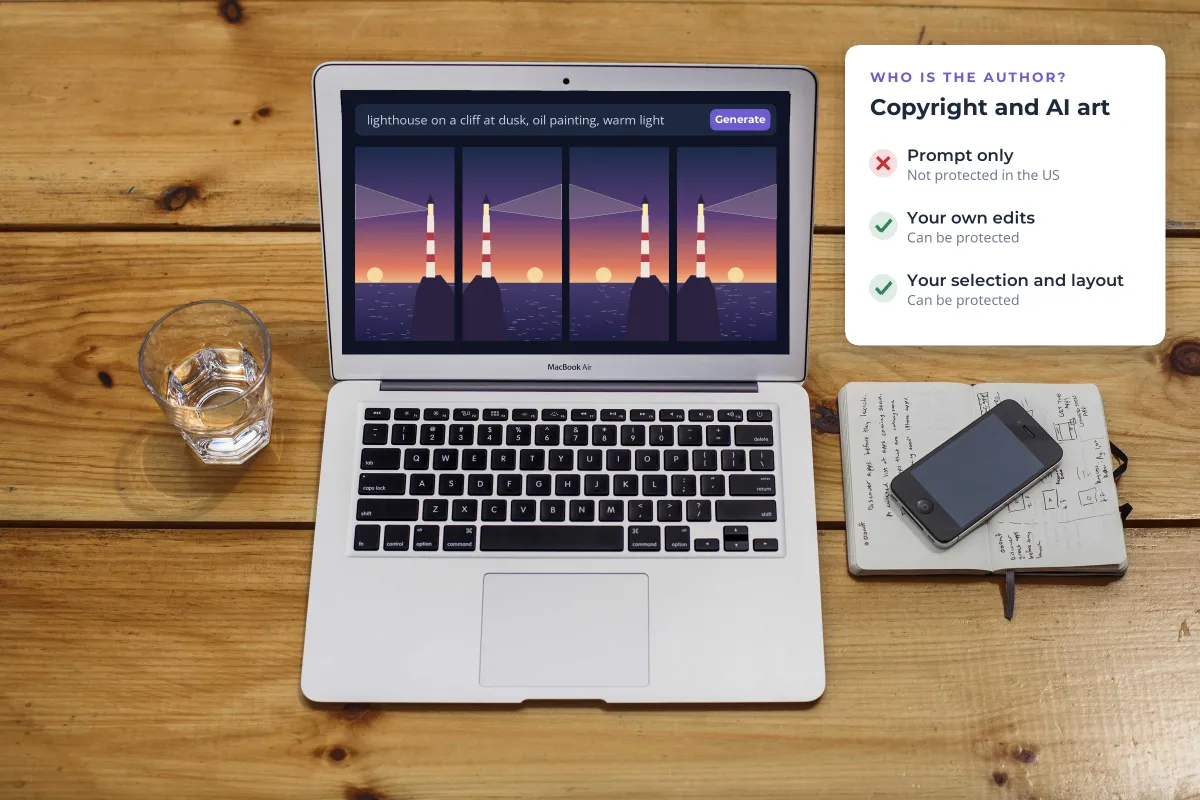
Can you copyright AI art? As of 2026, the answer in the US is: not the parts the AI generated, but yes the parts a human created. An image produced from a text prompt, even a long and carefully tuned one, has no human author in the legal sense, so it gets no copyright. Your own text, drawing, edits and arrangement around it can.
- United States: copyright requires a human author. Prompting alone is not enough. Human contributions to an AI-assisted work are protected, and the AI-generated parts must be disclosed when you register.
- United Kingdom: the law still protects "computer-generated works" for 50 years, but how it applies to AI is unclear, and in March 2026 the government proposed removing that protection.
- European Union: protection requires the author’s own intellectual creation, which is widely understood to mean a human making creative choices.
- In practice: others may be free to copy a purely AI-generated image, and you cannot register it as your own.
The US Position: Human Authorship Is Required
US copyright law has never defined "author", but the Copyright Office and the courts have long read it to mean a human being. Generative AI put that reading to the test, and so far it has held.
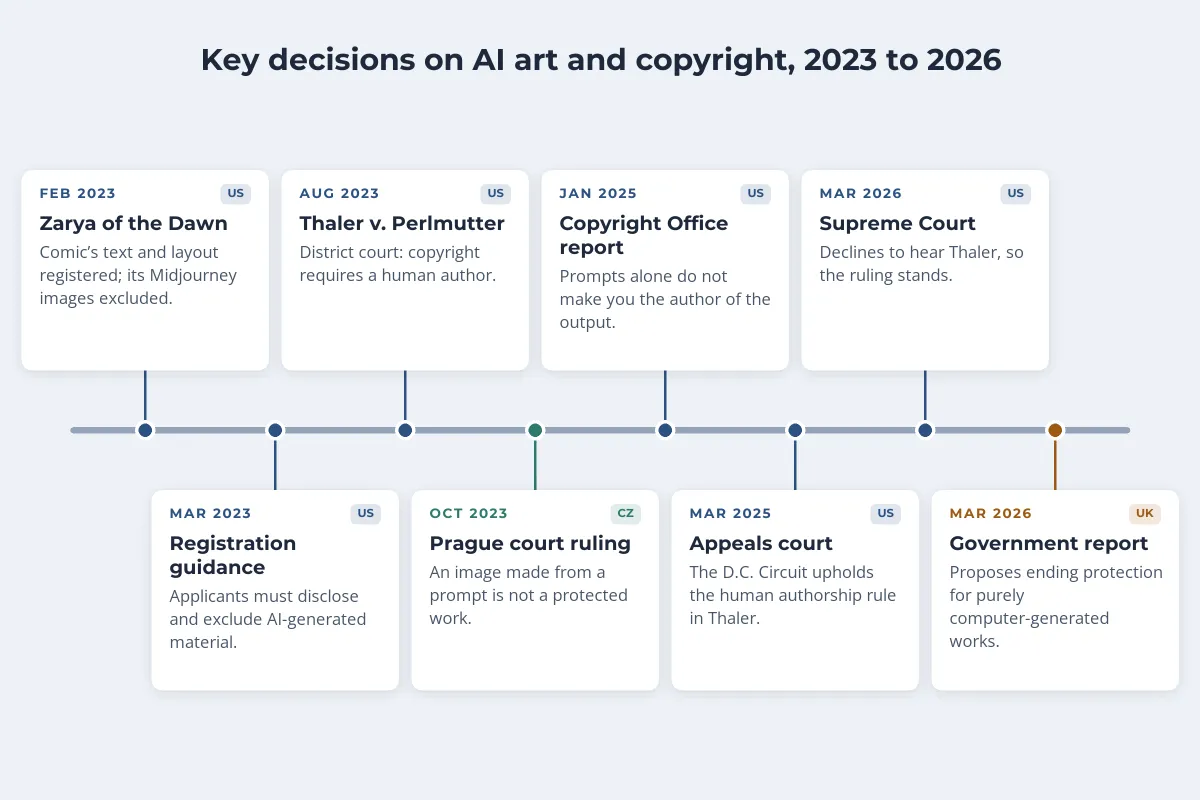
- Zarya of the Dawn (February 2023). The Copyright Office let the author of a comic book keep her registration for its text and for her selection and arrangement of text and images. The individual images, made with Midjourney, were excluded.
- Registration guidance (March 2023). The Office told applicants to disclose AI-generated material that is more than minimal, describe the human contribution, and leave the AI-generated parts out of the claim.
- Thaler v. Perlmutter (2023 to 2026). Stephen Thaler tried to register an image called "A Recent Entrance to Paradise", listing his AI system as its author and claiming no creative role himself. A federal court rejected it in August 2023, the D.C. Circuit agreed in March 2025, and on March 2, 2026 the Supreme Court declined to hear the case.
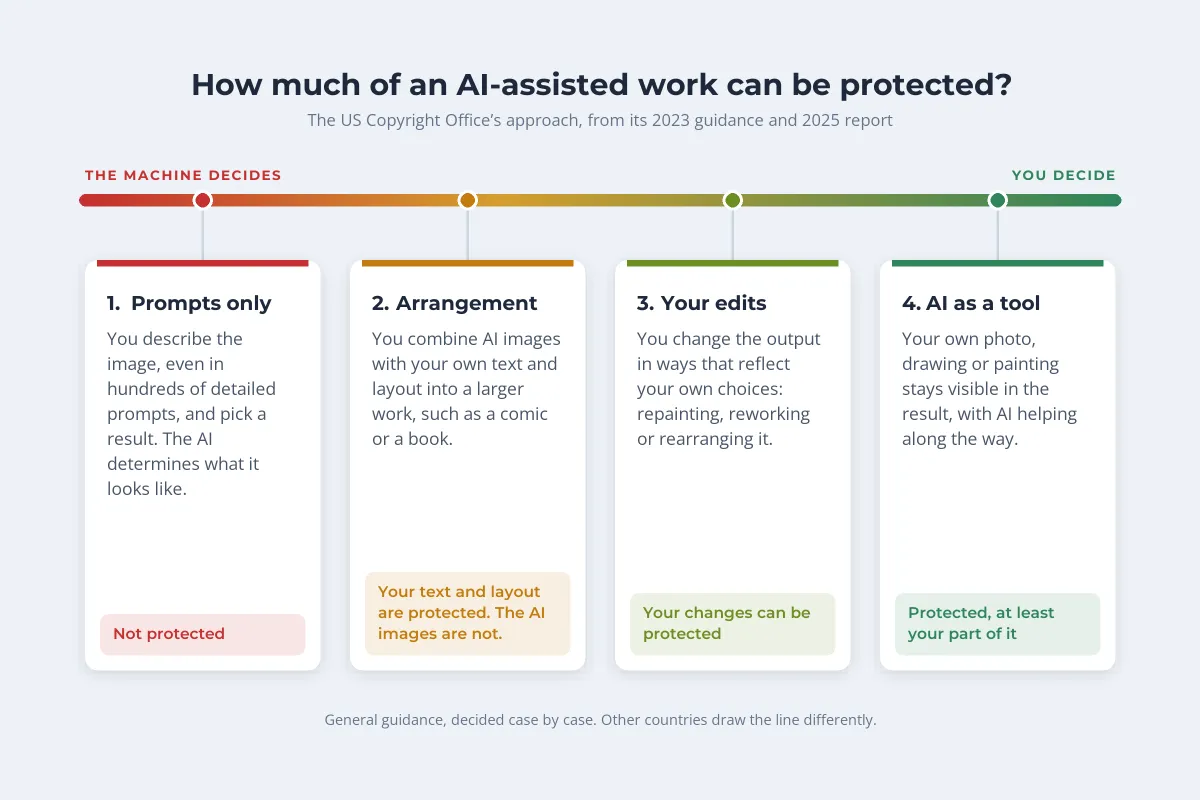
- Copyright and Artificial Intelligence, Part 2 (January 2025). The Copyright Office concluded that existing law already handles AI, that using AI as a tool does not bar protection, and that outputs are protected only where a human has determined enough of their expressive elements. Prompts alone, it said, do not give that control.
One open question is how much human involvement is enough. The Thaler courts did not need to answer it, because Thaler disclaimed any contribution. A separate case brought by the artist Jason Allen, whose Midjourney-based image won a prize at the Colorado State Fair in 2022, argues that more than 600 prompts and his edits should count. As of late summer 2026 it was still waiting for a decision in federal court in Colorado.
What Human Contribution Counts
According to the Copyright Office, three kinds of human input can make an AI-assisted work protectable, at least in part:
- Your own work as the input. If you feed in your own drawing, painting or photo and it stays perceptible in the output, you are the author of at least that part.
- Selection and arrangement. Choosing AI images and combining them with your text and layout into a larger work, such as a book, a comic or a collage, can be protected as a compilation. The individual images still are not.
- Creative modifications. Reworking the output by hand, painting over it or rearranging its elements in ways that reflect your own choices can be protected, to the extent of your changes.
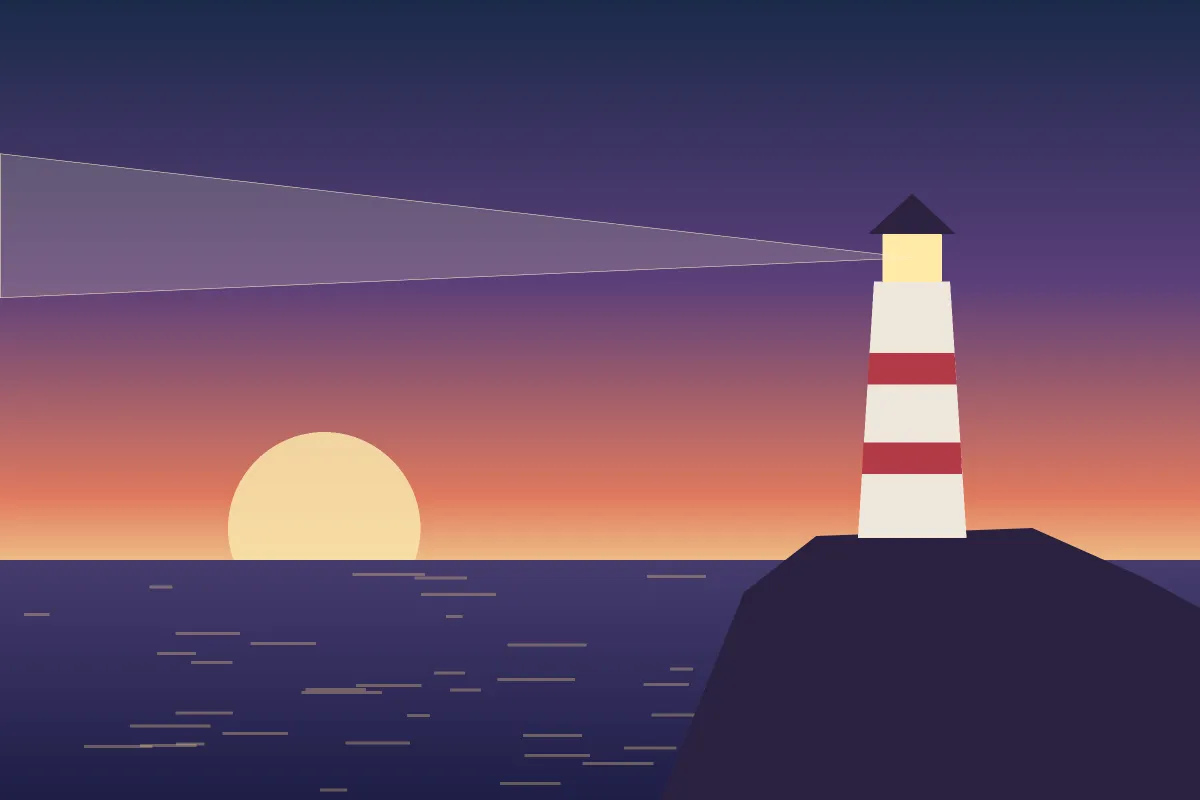 Generated
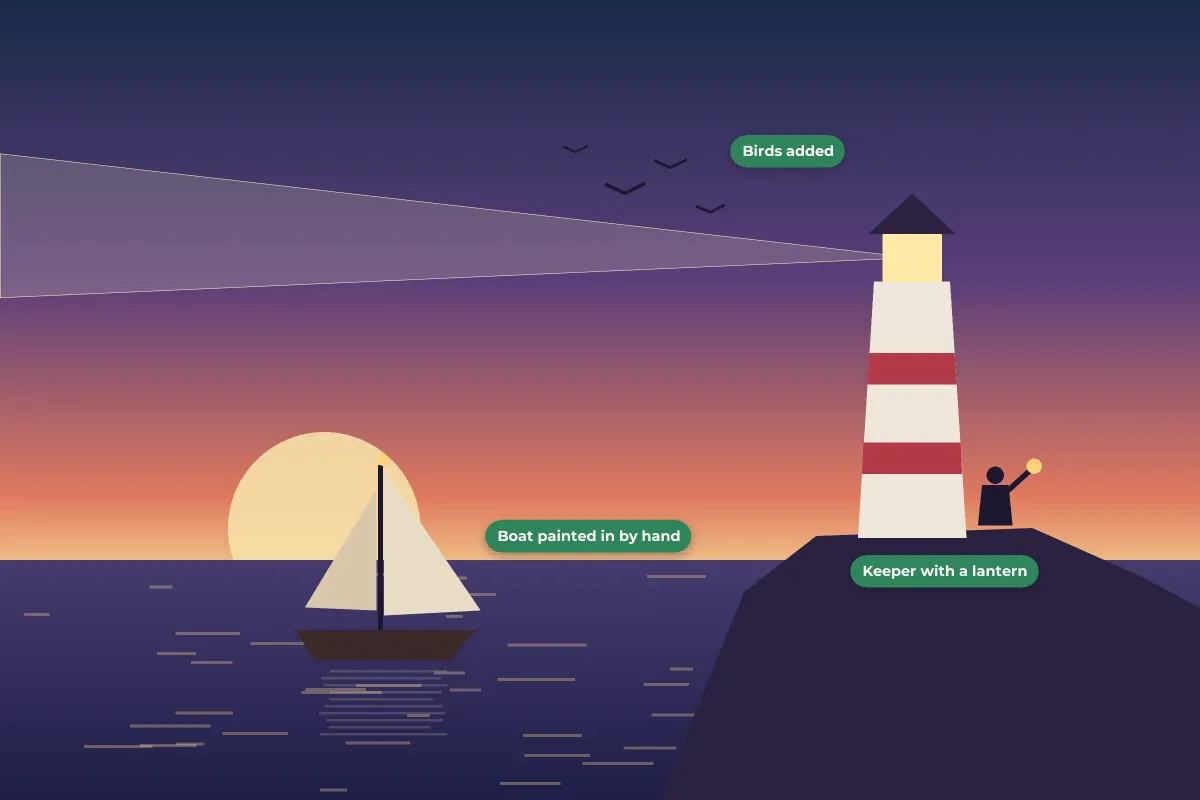 After your edits
In a case like this, the boat, the birds and the keeper are yours and can be protected. The generated lighthouse, sea and sky underneath them still are not, so someone could reuse the original output without infringing your additions.
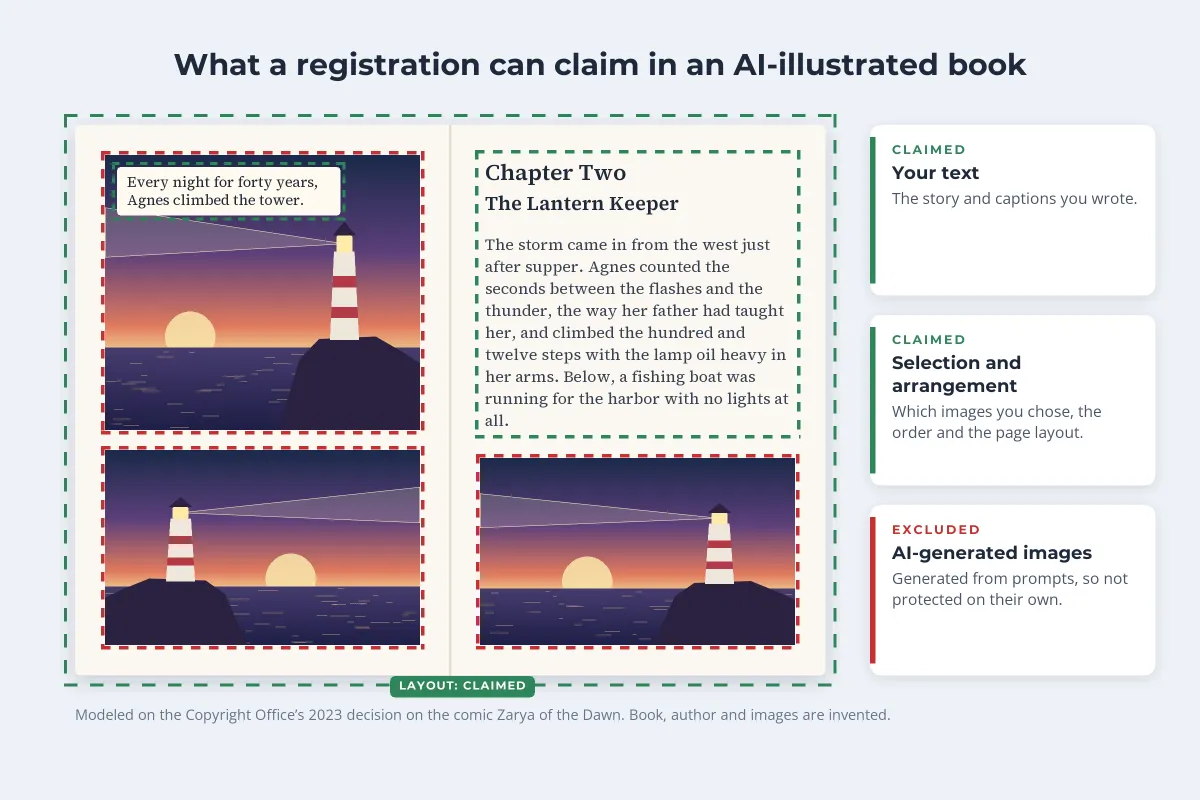
What does not count is the idea, the style you asked for, or the effort of writing and rewriting prompts. The Office’s reasoning is that a prompt works like instructions to an artist: the instructions are yours, but the picture is drawn by something else. Copyright has never protected ideas, only the specific way they are expressed.
How to Register an AI-Assisted Work in the US
-
Identify your contribution
Be clear about what you created: the text, a drawing, the edits, the selection and arrangement.
-
Disclose the AI-generated parts
In the application, describe the AI-generated material that is more than minimal and exclude it from your claim.
-
Describe the human authorship
Explain briefly what you did, for example "text, selection, coordination and arrangement of text and images".
-
Keep records of your process
Save sketches, layered files, drafts and notes on which parts you made yourself. They support your claim if it is ever questioned.
-
Correct older registrations
If you registered a work without disclosing AI material, the Office’s guidance says to fix it with a supplementary registration.
An application that hides AI-generated material risks the registration later being challenged, which matters because registration is what makes statutory damages and attorney’s fees available in US infringement cases. For when registering is worth it in general, see should you register your photo copyright.
The UK, the EU and Elsewhere
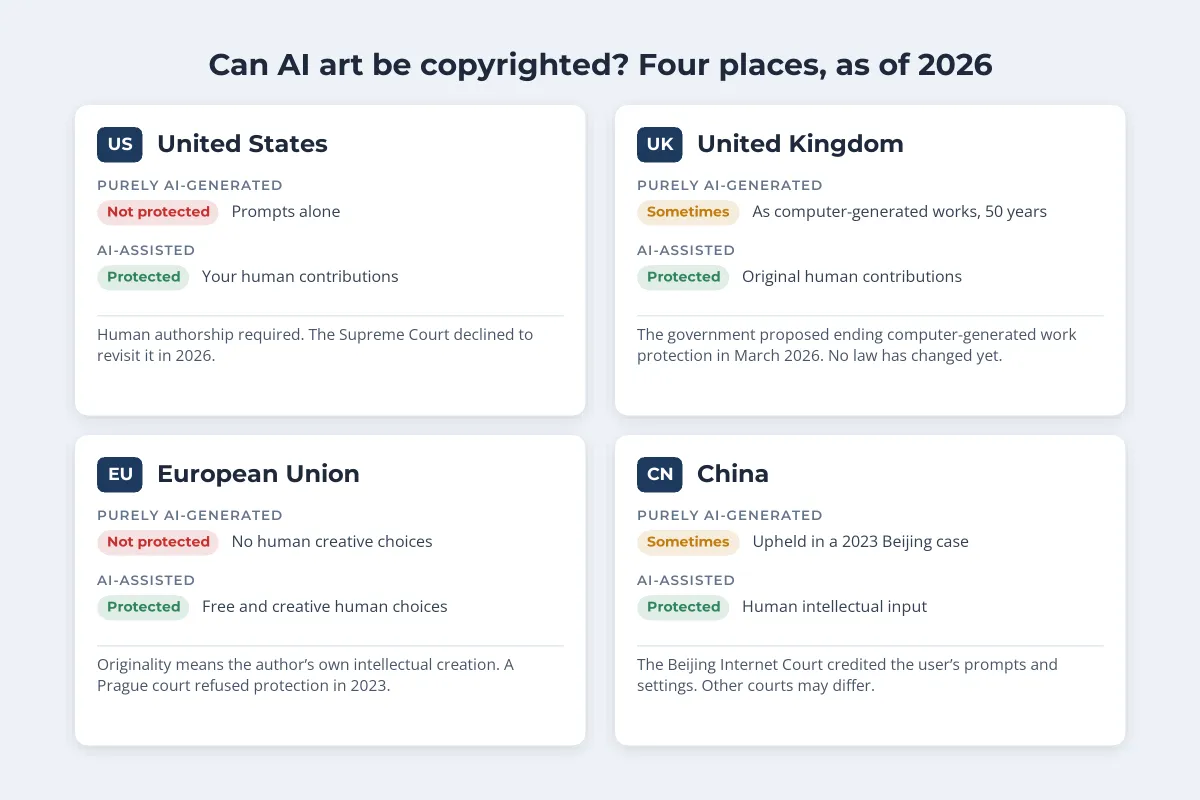
- United Kingdom. Since 1988, section 9(3) of the Copyright, Designs and Patents Act has covered works "generated by computer" with no human author. The author is the person who made the arrangements needed to create the work, and protection lasts 50 years from when it was made. Nobody is sure how that applies to modern AI, and its requirement of originality is hard to square with a work no human created. In its March 2026 report on copyright and AI, the government proposed removing this protection while keeping copyright for AI-assisted works with real human creativity. No legislation had been introduced at the time of writing.
- European Union. There is no special rule for computer-generated works. EU case law requires a work to be the author’s own intellectual creation, shown through free and creative choices. The Court of Justice developed that test in a case about portrait photographs, Painer (2011). In October 2023, the Municipal Court in Prague applied it to refuse protection for an image generated from a prompt, saying it was not the creative result of a natural person.
- China. In November 2023, the Beijing Internet Court took the opposite view in Li v. Liu. It found that a user who chose prompts and parameters in Stable Diffusion and refined them repeatedly had made an intellectual contribution, and protected the resulting image. The ruling turned on that user’s documented process, so it is not a blanket rule that every AI image is protected in China.
Labeling rules are a separate matter. The EU AI Act and similar laws require some AI-generated content to be disclosed or marked, but a label says nothing about who owns the content. For how those labels and hidden marks work, see invisible watermarks and Content Credentials, and for which generators add which marks, how AI image generators mark their pictures. For how copyright differs more generally, see copyright laws by country.
What This Means for Artists and Businesses
- A purely AI-generated image is weak property. In the US and much of Europe, someone who copies it may face no copyright claim at all. Logos, product shots and artwork you need to defend should carry real human authorship.
- A generator’s terms are not copyright. Many AI services say you own your outputs. That settles matters between you and the service, but it cannot create a copyright the law does not grant.
- AI output can still infringe. An image that closely resembles an existing work can infringe that work, whoever or whatever made it. Lawsuits over training AI on artists’ work are also ongoing; see how to protect your art from AI training, and Glaze vs Nightshade for two tools artists use against it.
- Commissions and clients. If you sell AI-assisted work, say so. A client paying for exclusive rights may be buying parts nobody can own.
This area is moving fast, and the outcome of a real dispute depends on its facts and the country involved. For a work that matters commercially, ask a copyright lawyer.
A visible watermark does not create copyright, but it still does useful work on AI-assisted art: it says who made and published the piece and makes a clean copy harder to pass off. Watermark.ws adds a text or logo watermark to images, GIFs and videos in a batch. It does not add hidden or forensic marks.
Sample photos: Laptop on a desk by Alejandro Escamilla on Unsplash.