On this page
Owning a Copyright vs. Registering It
Copyright in a photo exists automatically from the moment it is taken. You do not need to register it, publish it or put a notice on it to own it. Registration with the US Copyright Office is something else: an official public record of your claim, with a certificate to prove it.
For most everyday purposes — sending a takedown notice, asking someone to credit or remove your photo, licensing your work — registration makes no difference. It matters when a dispute becomes a legal case in the United States. That is where unregistered photographers discover that owning a copyright and being able to enforce it effectively are not the same thing.
This article covers registration with the US Copyright Office under US law, with the relevant sections linked. Most countries have no comparable registration system, and none is needed to own copyright. For decisions about a real dispute, talk to a copyright lawyer.
What Registration Gets You
| Not registered | Registered in time | |
|---|---|---|
| Suing in a US federal court | Not possible for a US work until it is registered (17 U.S.C. § 411(a)). | Possible. |
| Statutory damages | Not available for infringements that began before registration. | $750 to $30,000 per work, up to $150,000 if the infringement was willful (§ 504(c)). |
| Attorney's fees | Not available for those infringements. | The court may award them (§ 505). |
| Evidence of ownership | You have to prove it from scratch. | A certificate issued within five years of first publication is prima facie evidence (§ 410(c)). |
| Copyright Claims Board (small claims) | Available once you have applied; statutory damages capped at $7,500 per work. | Statutory damages capped at $15,000 per work. |
The row that matters most is statutory damages. Actual damages — the license fee you lost, or the infringer's profits — are often small for a single photo. Statutory damages let a court award a set amount per work without proving exactly what you lost, and attorney's fees make it realistic to bring a case at all. Without them, many photo cases are not worth pursuing.
Timing also matters for when you can act. Since the Supreme Court's decision in Fourth Estate v. Wall-Street.com (2019), you cannot sue over a US work until the Copyright Office has actually registered it — or refused it — not merely received the application. Registering only after you find an infringement means waiting for the Office to process it before you can file.
The Three-Month Window
Statutory damages and attorney's fees depend on when you register, compared with when the infringement began. The rule is in 17 U.S.C. § 412:
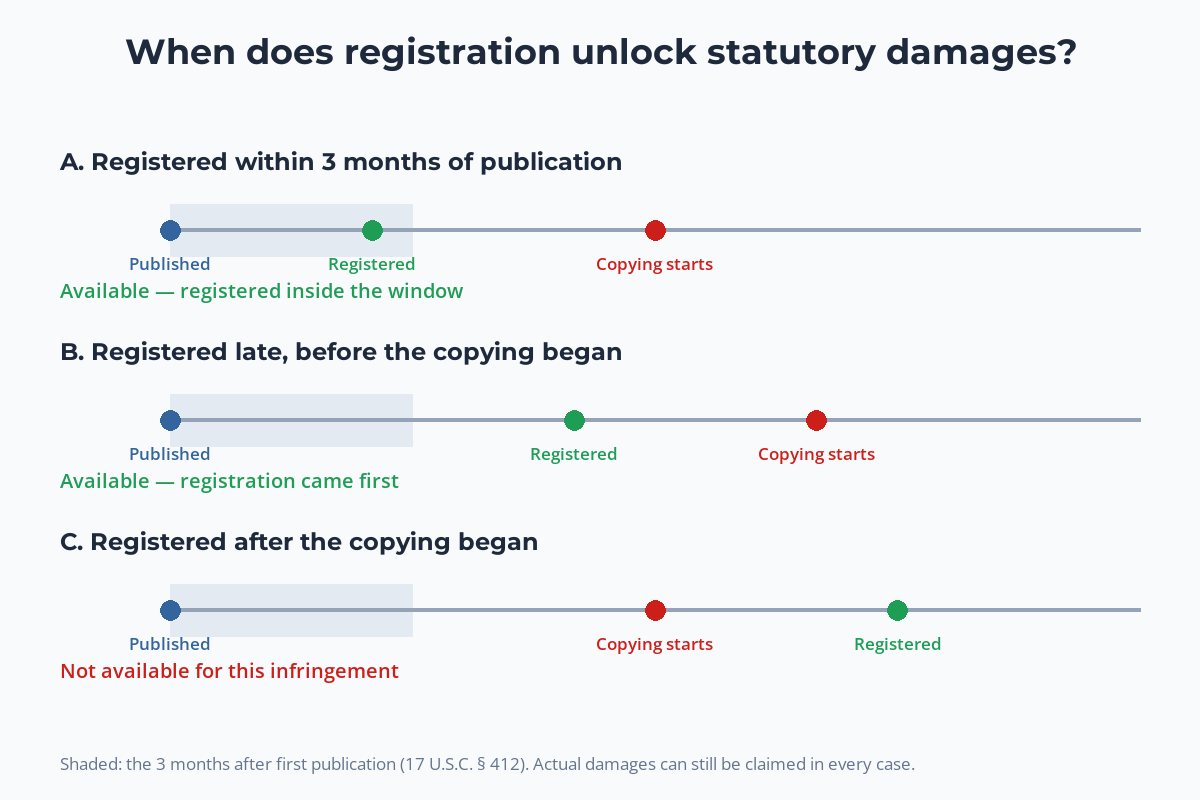
- Registered within three months of first publication: statutory damages and fees are available, even for an infringement that began before the registration.
- Registered later, but before the infringement began: available.
- Registered after the infringement began (and outside the three-month window): not available for that infringement. You can still claim actual damages.
- Unpublished photos: there is no grace period. Only infringements that begin after registration qualify.
If you are going to register, register regularly — for example, a batch of the photos you published each quarter. Registering "when something goes wrong" is almost always too late for statutory damages on that particular infringement.
Registering Photos in Groups
Registering photos one by one would be impractical, so the Copyright Office offers group registration options designed for photographers. The two most useful are:
| Option | Up to | Main requirements |
|---|---|---|
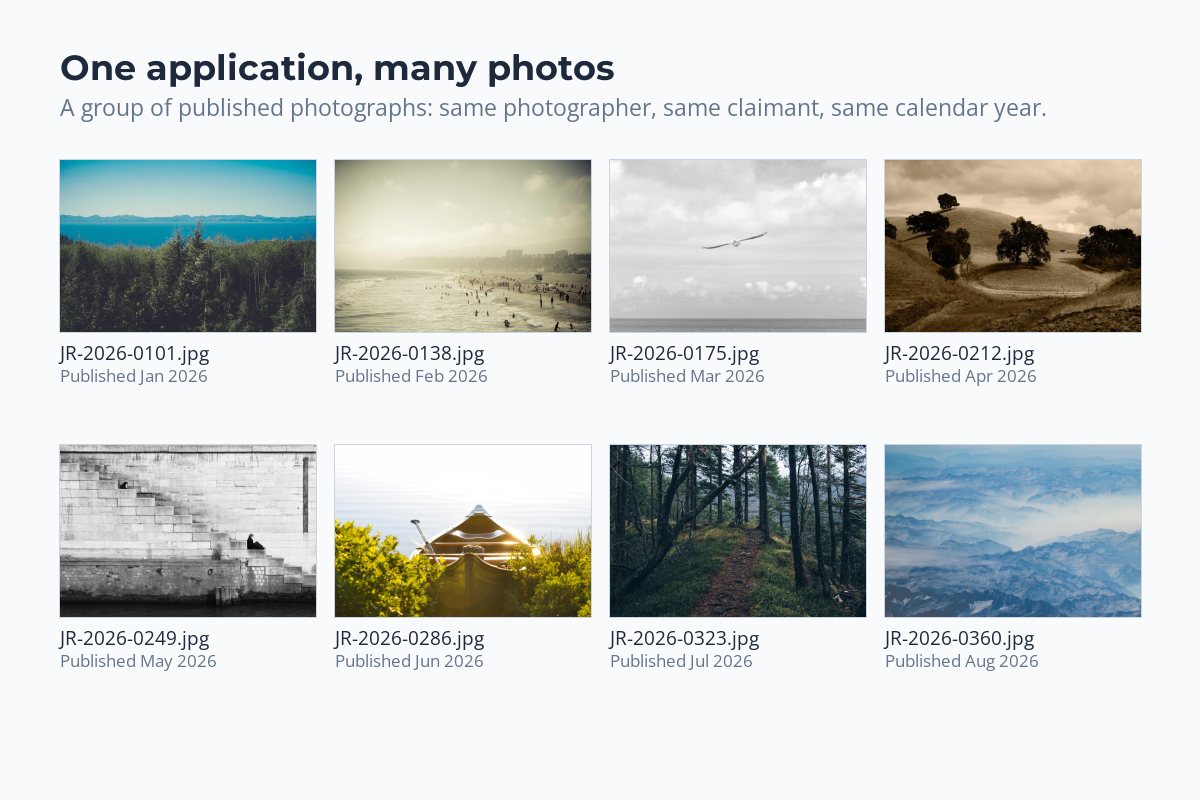
| Group registration of published photographs | 750 photos | Same photographer (author) and same claimant for every photo; all published in the same calendar year; the month of publication for each photo. |
| Group registration of unpublished photographs | 750 photos | Same photographer and same claimant; none of the photos published. |
Both are filed online through the Copyright Office's electronic registration system, with a digital copy of each photo and a list of titles and file names. The Office publishes guidance, application previews and title-list templates for each option. "Published" has a specific legal meaning, and whether posting a photo online counts is not always obvious — the Office's guidance on photographs explains how to decide.
The fees are modest. At the time of writing, the Copyright Office fee schedule lists:
| Registration | Fee at the time of writing |
|---|---|
| Group of published photographs (up to 750) | $55 |
| Group of unpublished photographs (up to 750) | $55 |
| Single application (one work, one author who is also the claimant, not made for hire) | $45 |
| Standard application | $65 |
Fees change from time to time, so check the fee schedule before you file. Spread over hundreds of photos, a group registration costs very little per image.
Is It Worth It for You?
Registration is a bit of admin and a small fee in exchange for options you may never use. Whether that trade makes sense depends on your work:
- Register if you license or sell your photos for a living.
- Register if your work is copied often — stock, travel, product and architecture photos are common targets.
- Register if you publish mainly in the US or to US audiences.
- Register work you care about protecting soon after publishing it, in regular batches.
- Keep a simple record of what you published and when.
- Expect registration to stop copying — it only changes what you can do afterwards.
- Wait until you find an infringement before registering.
- Mix photographers or claimants in one group application.
- Guess at publication dates; approximate months are accepted, invented ones are not a good idea.
- Skip takedowns and simpler routes just because you are registered.
For a hobbyist posting holiday photos, registration is rarely worth the effort. For a professional whose images have real licensing value, regular group registration is one of the cheapest forms of insurance available.
How to Register a Group of Photos
-
1
Create an account
Sign up for the Copyright Office's online registration system at copyright.gov.
-
2
Choose the right group option
Published or unpublished photographs. Every photo in the group must be by the same photographer and belong to the same claimant; published photos must share a calendar year.
-
3
Prepare the list and the files
A title and file name for each photo — and, for published photos, the month of publication. The Office provides a spreadsheet template.
-
4
Upload and pay
Upload a digital copy of each photo and pay the fee. The effective date of registration is generally the day the Office receives a complete application, fee and copies.
-
5
Keep the certificate
Processing takes time; the Office publishes current processing times on its website. Store the certificate with your originals.
If You Are Not in the US
Most countries have no copyright registration system, and none is needed to own copyright. The US rules still matter if your photos are copied by US sites or businesses. The requirement to register before suing applies to "United States works", so a photo first published abroad can generally be sued on in the US without registration. But the rule tying statutory damages and fees to timely registration applies regardless of where the photo came from. For how enforcement works in other countries, see copyright laws by country.
Registration and Watermarks Work Together
Registration and watermarking protect you at different moments. A watermark works before any copying happens: it deters casual theft, credits you when the photo is shared, and tells a support team who owns it when you file a takedown. Registration works after: it decides what you can recover if a case goes to court.
There is also a direct link between them. A watermark containing your name or a copyright notice is copyright management information under US law, and knowingly stripping it to hide an infringement is a separate violation with its own statutory damages — whether or not the photo is registered. Watermark what you publish, and register what you cannot afford to lose.
Sample photos: Coastline by Paul Jarvis, Beach by Tina Rataj, Gull by Ryan Jacques, Hills by Noel Lopez, Stairs by Elisabetta Foco, Canoe by Michael Quinn, Forest path by Ales Krivec, Mountains from above by Dominik Lange on Unsplash.