On this page
- What Fair Use Actually Is
- The Four Factors
- How the Factors Tend to Play Out for Photos
- The Warhol Case: A Win for Photographers
- Five Myths That Get People in Trouble
- Outside the US: Fair Dealing and Fixed Exceptions
- When Someone Says Their Use of Your Photo Is Fair Use
- If You Want to Use Someone Else's Photo
What Fair Use Actually Is
Fair use is part of United States copyright law. It allows some uses of a copyrighted work without permission, and it exists to protect things like criticism and news reporting that would be impossible if every quote or image needed a license.
The statute, 17 U.S.C. § 107, lists example purposes — "criticism, comment, news reporting, teaching (including multiple copies for classroom use), scholarship, or research" — and says that fair use for purposes such as these is not an infringement. But falling into one of those categories does not make a use fair on its own. Every case is weighed on four factors, and the outcome depends on all the circumstances.
Two points are easy to miss. Fair use is usually raised as a defense, after someone has been accused of infringement. And it is a US concept: most other countries do not have it, and use narrower, fixed lists of exceptions instead.
This article explains how fair use works in general terms. Whether a specific use is fair depends on its facts, and courts sometimes disagree. For a real dispute, speak to a copyright lawyer.
The Four Factors
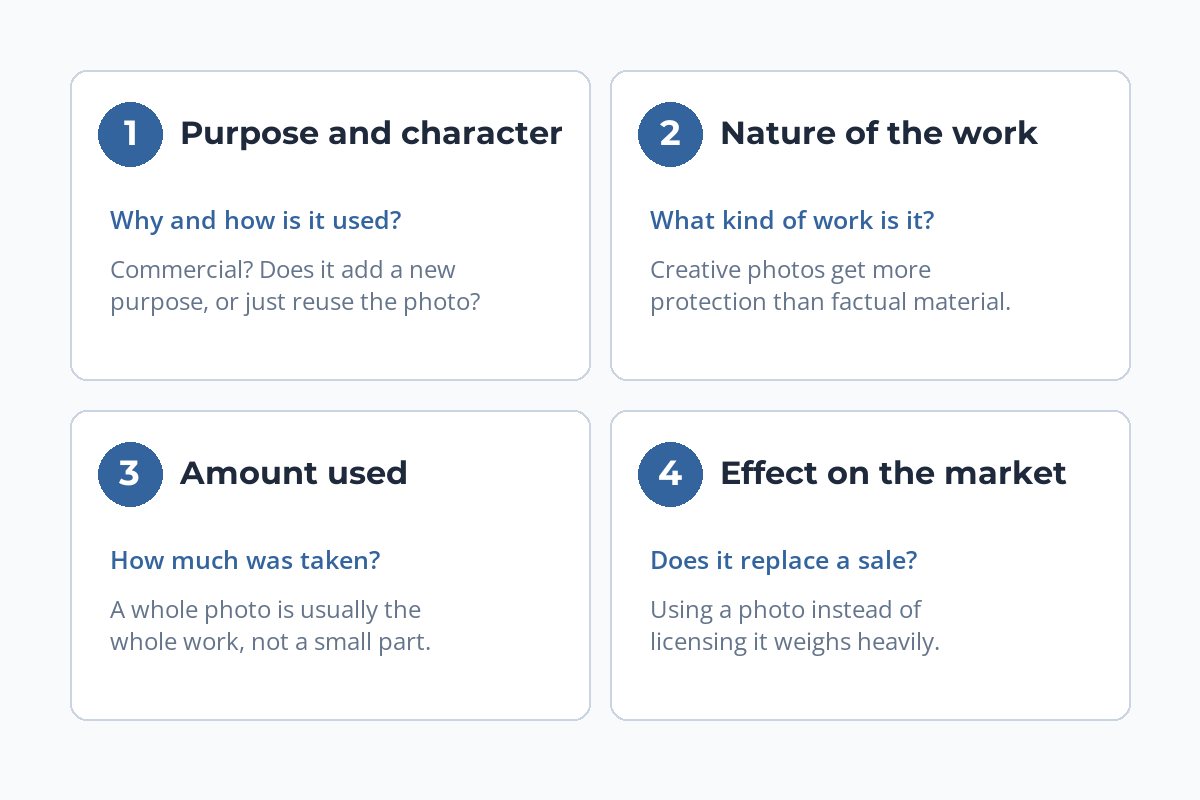
Section 107 tells courts to consider:
- The purpose and character of the use, including whether it is commercial or for nonprofit educational purposes. The US Copyright Office notes that courts also look at whether a use is transformative — whether it adds something new, with a further purpose or different character, and does not substitute for the original.
- The nature of the copyrighted work. According to the Copyright Office, using a more creative or imaginative work is less likely to support fair use than using a factual one.
- The amount and substantiality of the portion used, in relation to the work as a whole.
- The effect of the use on the potential market for, or value of, the work. Courts ask whether the unlicensed use harms the existing or future market for the original.
How the Factors Tend to Play Out for Photos
Photos are an unusual case, because a photo is usually used whole and usually used for the very reason it was made: to be looked at. That shapes how the factors tend to land.
| Factor | Tends to favor the photographer when… | Tends to favor the user when… |
|---|---|---|
| Purpose | The photo is used as decoration or illustration, especially commercially. | The use comments on or criticizes the photo itself, or adds a genuinely new purpose. |
| Nature | The photo is creative: composed, lit and styled. | The photo is largely factual, or was already published. |
| Amount | The whole photo is used — which is common. | Only as much as the new purpose needs is used. |
| Market | The use replaces a license the photographer could have sold. | Nobody would license the photo for that purpose anyway. |
These are tendencies, not rules. Real cases turn on specific facts, and the factors are weighed together.
The Warhol Case: A Win for Photographers
The most important recent fair use decision involving a photograph is Andy Warhol Foundation for the Visual Arts, Inc. v. Goldsmith, decided by the US Supreme Court in May 2023. Lynn Goldsmith had photographed the musician Prince. Andy Warhol later made a series of works based on her photo, and in 2016 the Warhol Foundation licensed one of them to a magazine publisher for a cover.
The Court ruled 7–2 that the first factor — purpose and character — did not favor the Foundation for that licensing. The use served essentially the same commercial purpose as Goldsmith's photo: illustrating a magazine story about Prince. Adding a new look or meaning was not enough on its own when the use competed with the original in the same market.
For photographers, the lesson is reassuring: restyling or filtering a photo does not automatically make a commercial use of it fair, especially when it stands in for the kind of license the photographer sells.
Five Myths That Get People in Trouble
| The myth | The reality |
|---|---|
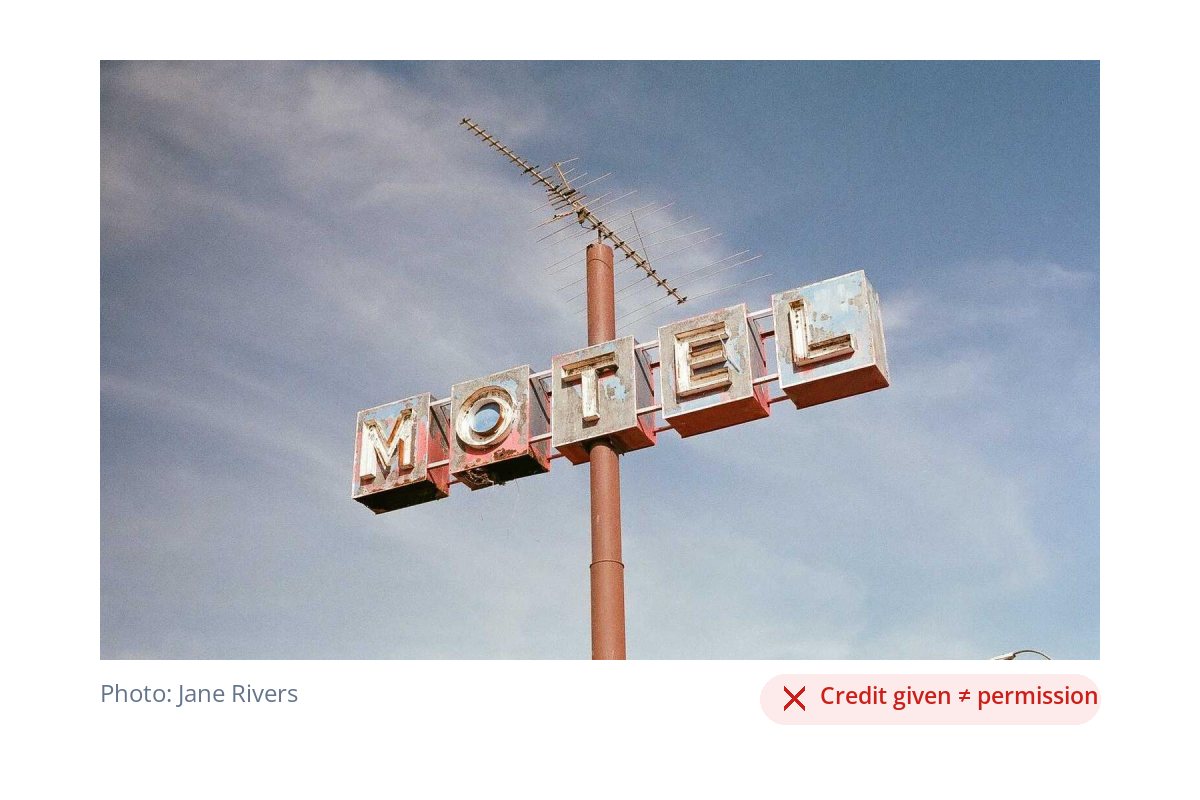
| "I credited the photographer, so it's fine." | Credit is not permission. The Copyright Office recommends getting permission in cases of doubt, and a credit line does not change the four factors. |
| "It was on the internet, so it's public." | Being viewable is not the same as being free to use. Copyright exists from the moment a photo is taken, whether or not it has a notice or a watermark. |
| "It's non-commercial, so it's fair use." | Non-commercial use helps, but the Copyright Office is clear that this does not mean all non-commercial uses are fair. |
| "I only used a small part" or "I changed it by 30%." | There are no rules allowing a specific percentage of a work, according to the Copyright Office. And with photos, the "part" used is often the whole thing. |
| "I bought the print, so I can post it." | Owning a copy is not owning the copyright. US law treats ownership of the copyright as distinct from ownership of the physical object (17 U.S.C. § 202). |
Outside the US: Fair Dealing and Fixed Exceptions
If you or the person using your photo is outside the United States, fair use probably does not apply at all. Many countries instead have specific, listed exceptions.
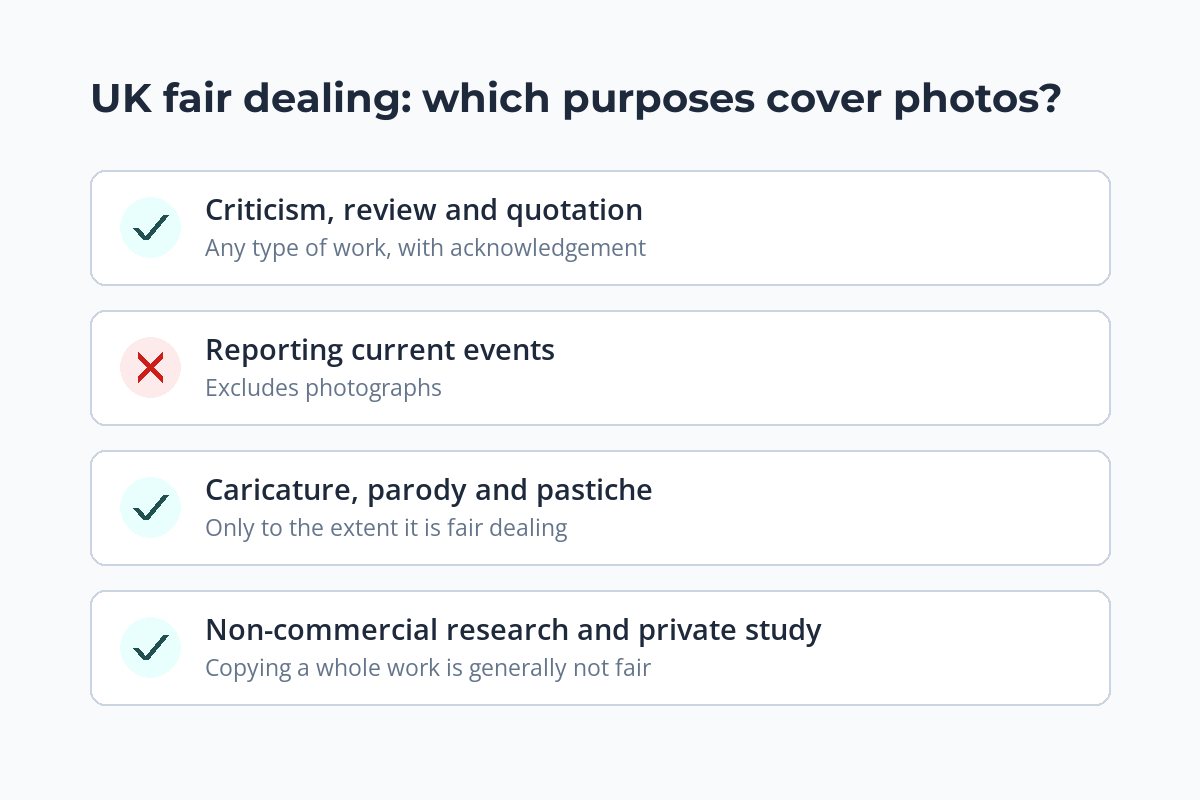
- United Kingdom: "fair dealing" covers set purposes. The UK government's guidance says fair dealing for criticism, review and quotation is allowed for any type of work — but fair dealing for reporting current events is allowed for any type of work other than a photograph. A newsworthy photo cannot simply be reproduced under that exception.
- European Union: there is no general fair use doctrine. The 2001 Copyright Directive (2001/29/EC) sets out a list of exceptions, such as quotation for criticism or review, that member states may choose to adopt, so the details differ between countries.
- Elsewhere: countries such as Canada and Australia also use fair dealing with defined purposes, and the rules vary. See copyright infringement laws by country for a country-by-country overview.
When Someone Says Their Use of Your Photo Is Fair Use
"It's fair use" is often the first reply to a takedown request, and it is sometimes said without much thought. You do not have to accept it — or argue it out yourself.
-
1
Look at what they are actually doing
Is your photo the subject of commentary or criticism, or is it simply decorating their page or selling their product?
-
2
Check the market effect
Would this user normally have needed to license a photo for this purpose? If so, their use may be replacing a sale.
-
3
Keep your evidence and correspondence
Follow the steps in what to do when someone steals your photos.
-
4
Get advice when it matters
Fair use is fact-specific. If the use is commercial and significant, a copyright lawyer can tell you how the factors are likely to be weighed.
If You Want to Use Someone Else's Photo
The safest route is almost never to rely on fair use. It is to use a photo you have a clear right to use:
- Ask. Many photographers say yes, especially for credit or a small fee. The Copyright Office suggests contacting the owner directly if you know who they are.
- License it from the photographer or a stock library. See how photo licensing works.
- Use openly licensed photos, following the license terms exactly. See Creative Commons licenses explained.
- Take your own.
A visible watermark with your name or website tells anyone who likes your photo exactly who to ask. Many "fair use" arguments start with people who could not work out who took a photo. See what to write in a watermark.
Sample photos: Photographer by Jennifer Trovato, Motel sign by Steven Lewis on Unsplash.