
On this page
Two Different Wrongs
This article summarizes the laws of 10 countries as they stood at the time of writing, with links to the official texts. Laws change, courts interpret them, and the details of your case matter. If you are considering legal action, speak to a lawyer who practises copyright law in the relevant country.
When someone takes your photo and uses it without permission, two separate things can go wrong, and the law often treats them differently.
The first is copyright infringement: copying, publishing or sharing a photo without the owner’s permission. In almost every country, a photo is protected by copyright automatically, the moment it is taken. No registration, © symbol or watermark is needed for it to be yours.
The second is removing or altering rights management information — the information that identifies the photo, its author or owner, or the terms of use. Most major copyright laws have a specific rule against stripping that information to hide an infringement, because of two international treaties from 1996, the WIPO Copyright Treaty and the WIPO Performances and Phonograms Treaty. That rule is where watermarks come in.

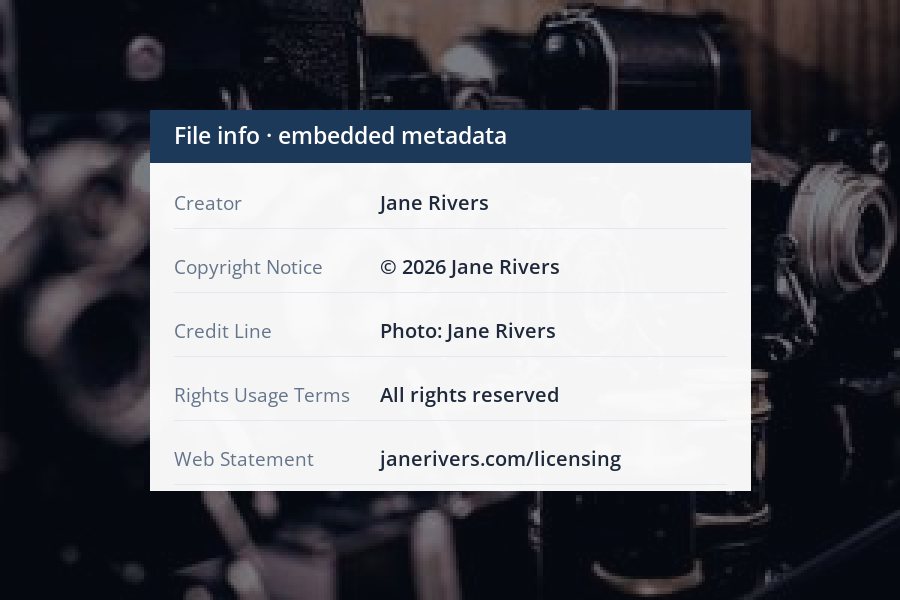
Some countries protect both kinds. Others protect only “electronic” rights management information, which clearly covers embedded metadata and may or may not cover a visible watermark in a digital photo. The country sections below say which.
- Using your photo without permission can lead to damages, court orders and, in serious or commercial cases, criminal penalties in every country below.
- Removing your watermark or credit to hide the copying is a separate violation in all 10 countries, with its own penalties in several.
- The US stands out for fixed “statutory” damages, including $2,500–$25,000 per removed or altered credit.
- Your best protection is still practical: keep your originals, embed your details in metadata, and watermark what you share.
The 10 Countries Side by Side
Penalties are maximums or statutory ranges set by law. Courts decide the actual amount case by case, and criminal penalties generally apply only to intentional, commercial or large-scale conduct.
| Country | Using a photo without permission | Removing a watermark or credit |
|---|---|---|
| United States | Actual damages, or $750–$30,000 per work (up to $150,000 if willful), for registered works | $2,500–$25,000 per violation; up to $500,000 and 5 years in prison if willful and commercial |
| United Kingdom | Damages and injunctions, plus “additional damages” for flagrant cases; up to 10 years in prison for commercial offences | Same remedies as for infringement (electronic information) |
| Canada | $500–$20,000 per work (commercial) or $100–$5,000 in total (non-commercial) | All infringement remedies, including damages (electronic information) |
| Australia | Damages or profits, plus additional damages for flagrant infringement | Civil action; criminal offence of up to 5 years in prison and/or 550 penalty units |
| Germany | Damages, usually based on a license fee; up to 3 years in prison | Up to 1 year in prison or a fine (3 years if commercial) |
| France | Up to 3 years in prison and a €300,000 fine | €3,750 fine; 6 months and €30,000 for distributing stripped copies |
| Japan | Up to 10 years in prison and/or a ¥10 million fine | Treated as infringement; up to 3 years and/or ¥3 million if for profit |
| India | 6 months to 3 years in prison and a ₹50,000–₹2,00,000 fine | Up to 2 years in prison and a fine |
| China | Damages; ¥500–¥5 million when losses cannot be calculated; 1–5× punitive damages for serious intentional cases | Prohibited; civil liability, plus administrative fines where public interests are harmed |
| Brazil | 3 months to 1 year in prison or a fine; 2–4 years for copying for profit | Damages with a minimum set by law |
United States
Using a photo without permission. A copyright owner can recover their actual losses and the infringer’s profits, or choose statutory damages of $750 to $30,000 per work, which a court can raise to $150,000 per work for willful infringement (17 U.S.C. § 504). The catch: statutory damages and attorney’s fees are generally only available if the photo was registered with the US Copyright Office before the infringement began, or within three months of first publication (§ 412). See should you register copyright on your photos.
Removing a watermark or credit. Section 1202 of the Digital Millennium Copyright Act makes it unlawful to intentionally remove or alter “copyright management information” — which includes the author’s name, the owner’s name and the title — knowing, or having reasonable grounds to know, that it will induce, enable, facilitate or conceal infringement (17 U.S.C. § 1202). The owner can claim statutory damages of $2,500 to $25,000 per violation (§ 1203). Doing it willfully for commercial advantage or private financial gain is a crime: up to $500,000 and 5 years in prison for a first offence, and up to $1,000,000 and 10 years after that (§ 1204).
US law does not limit this to digital data. Federal courts have treated a visible credit naming the photographer — the kind of information a watermark carries — as copyright management information, including the Third Circuit in Murphy v. Millennium Radio Group (2011). If you need to take a copy down, see how to file a DMCA takedown notice.
United Kingdom
Using a photo without permission. The Copyright, Designs and Patents Act 1988 gives the owner damages, injunctions and other remedies. There are no fixed statutory damages, but a court can award “additional damages” based on how flagrant the infringement was and what the infringer gained from it (section 97). Criminal offences mainly cover commercial dealing and communicating works to the public in the course of a business, and carry up to 10 years in prison on indictment (section 107). Smaller claims can go to the small claims track of the Intellectual Property Enterprise Court, designed for claims of up to £10,000.
Removing a watermark or credit. Knowingly removing or altering “electronic rights management information”, with reason to believe it will enable or conceal infringement, gives the owner the same rights against that person as against an infringer (section 296ZG). The information protected is anything that identifies the work, the author or the owner, or the terms of use. Embedded metadata is clearly covered; whether a visible watermark in a digital file counts as “electronic” information has not been clearly settled.
Canada
Using a photo without permission. Instead of proving actual losses, an owner can elect statutory damages: $500 to $20,000 per work for commercial infringement, or $100 to $5,000 in total for all works if the infringement was non-commercial (Copyright Act, s. 38.1). Knowingly making or selling infringing copies commercially is a criminal offence, with fines of up to $1,000,000 and up to 5 years in prison on indictment (s. 42).
Removing a watermark or credit. No one may knowingly remove or alter rights management information “in electronic form” without the owner’s consent when they know, or should have known, that it will facilitate or conceal infringement. The owner is entitled to all remedies — injunction, damages, accounts and more — against the person who removed it and against anyone who knowingly distributes the stripped copies (s. 41.22).
Australia
Using a photo without permission. The Copyright Act 1968 lets the owner claim damages or the infringer’s profits, and the court can add “additional damages” for flagrant infringement. Australia does not have fixed statutory damages. Commercial-scale infringement can also be a criminal offence.
Removing a watermark or credit. Removing or altering “electronic rights management information” without permission can be pursued in a civil action (section 116B). Doing so knowing it will induce, enable, facilitate or conceal infringement is also a criminal offence, punishable by up to 550 penalty units, up to 5 years in prison, or both (section 132AQ). The dollar value of a penalty unit is set under the Crimes Act 1914 and is indexed. Both sections are in the Copyright Act 1968.
The European Union
Copyright law is national, but EU countries share a common framework. The InfoSoc Directive (2001/29/EC) requires every member state to protect electronic rights management information against removal and alteration (Article 7), and the Enforcement Directive (2004/48/EC) sets common rules on damages, which can be calculated as a lump sum based on the license fee the infringer should have paid. Germany and France below show how two member states apply this.
Germany
Using a photo without permission. The owner can demand that the use stops and claim damages, which are usually calculated as the license fee a legitimate user would have paid (§ 97 UrhG). Photographers also have the right to be named as the author (§ 13 UrhG), and German courts often add a surcharge — frequently doubling the fee — when a photo was used without credit. Cease-and-desist letters (Abmahnungen) are a common first step. Intentional unlawful use is also a crime, with up to 3 years in prison or a fine (§ 106 UrhG).
Removing a watermark or credit. Rights management information supplied by the rights holder must not be knowingly removed or altered where the person knows, or should know, that this facilitates or conceals infringement (§ 95c UrhG). Doing so other than for private use carries up to 1 year in prison or a fine, and up to 3 years when done commercially (§ 108b UrhG).
France
Using a photo without permission. Infringement (contrefaçon) is a criminal offence in France, punishable by up to 3 years in prison and a €300,000 fine, rising to 7 years and €750,000 when committed by an organized group (Article L335-2 of the Intellectual Property Code). Owners can also sue for civil damages, and French law gives authors strong moral rights, including the right to be credited.
Removing a watermark or credit. Knowingly removing or modifying rights management information in order to infringe, or to conceal or facilitate infringement, is punishable by a €3,750 fine. Knowingly distributing or making available a work from which that information has been removed carries up to 6 months in prison and a €30,000 fine (Article L335-3-2).
Japan
Using a photo without permission. Copyright infringement is punishable by up to 10 years in prison, a fine of up to ¥10 million, or both (Copyright Act, Article 119). Owners can also claim damages, and the Act includes rules that help calculate the amount of the loss.
Removing a watermark or credit. Intentionally adding false rights management information, or intentionally removing or altering it, is treated as an act of infringement (Article 113). Doing so for profit is punishable by up to 3 years in prison, a fine of up to ¥3 million, or both (Article 120-2). An English translation is published by the Copyright Research and Information Center.
India
Using a photo without permission. The Copyright Act, 1957 provides civil remedies — injunctions, damages and accounts of profits — and makes knowing infringement a criminal offence: at least 6 months and up to 3 years in prison, plus a fine of ₹50,000 to ₹2,00,000 (section 63).
Removing a watermark or credit. Since the 2012 amendments, knowingly removing or altering rights management information without authority — or knowingly distributing a work after that information has been removed — is punishable by up to 2 years in prison and a fine (section 65B).
China
Using a photo without permission. Under the Copyright Law as amended in 2020 (in force since June 2021), damages are based on the owner’s actual losses, the infringer’s illegal gains or a reference license fee. For serious, intentional infringement, courts can award 1 to 5 times that amount as punitive damages. Where none of these can be determined, the court sets damages of ¥500 to ¥5 million (Article 54). Serious cases can also lead to criminal liability.
Removing a watermark or credit. Intentionally deleting or altering rights management information without the owner’s permission is prohibited (Article 51). It carries civil liability, and where it also harms public interests, copyright authorities can confiscate illegal gains and impose fines of up to five times the illegal turnover, or up to ¥250,000 where turnover is low or unknown (Article 53).
Brazil
Using a photo without permission. Violating an author’s rights is a crime under Article 184 of the Penal Code: 3 months to 1 year of detention or a fine, and 2 to 4 years of imprisonment plus a fine when a work is reproduced for profit without authorization. Civil remedies come from the Copyright Law (Law 9,610 of 1998).
Removing a watermark or credit. Suppressing or altering rights management information without authorization makes the infringer liable for damages, with a minimum amount set by the law (Article 107). Using a photo without naming its author has its own consequence: besides damages, the infringer must publicly identify the author (Article 108).
What This Means for Your Photos
Two patterns hold across all 10 countries. Copying your photo without permission is unlawful whether or not it carries a watermark. And a watermark or metadata that names you gives you something extra: in every one of these countries, stripping that information to hide the copying is a violation in its own right.
-
1
Put your name in the photo and in the file
A visible watermark naming you, plus creator and copyright fields in the metadata, covers both the countries that protect only electronic information and those that protect any credit. See copyright in photo metadata.
-
2
Keep your originals
Full-resolution files and RAW files are the easiest way to prove a photo is yours, in any country.
-
3
Register where it counts
If you sell or license work in the United States, registration is what makes statutory damages and attorney’s fees available.
-
4
Document everything before you act
Screenshot the use, note the address and date, and check whether the user had a license. Then follow the steps in what to do when someone steals your photos.
A watermark will not stop a determined copier on its own — see can watermarks be removed? — but it makes casual copying less attractive, and when it is removed, it leaves you with a stronger case.
Sample photos: Vintage cameras by Mario Calvo on Unsplash.