On this page
How Traceable Watermarks Work
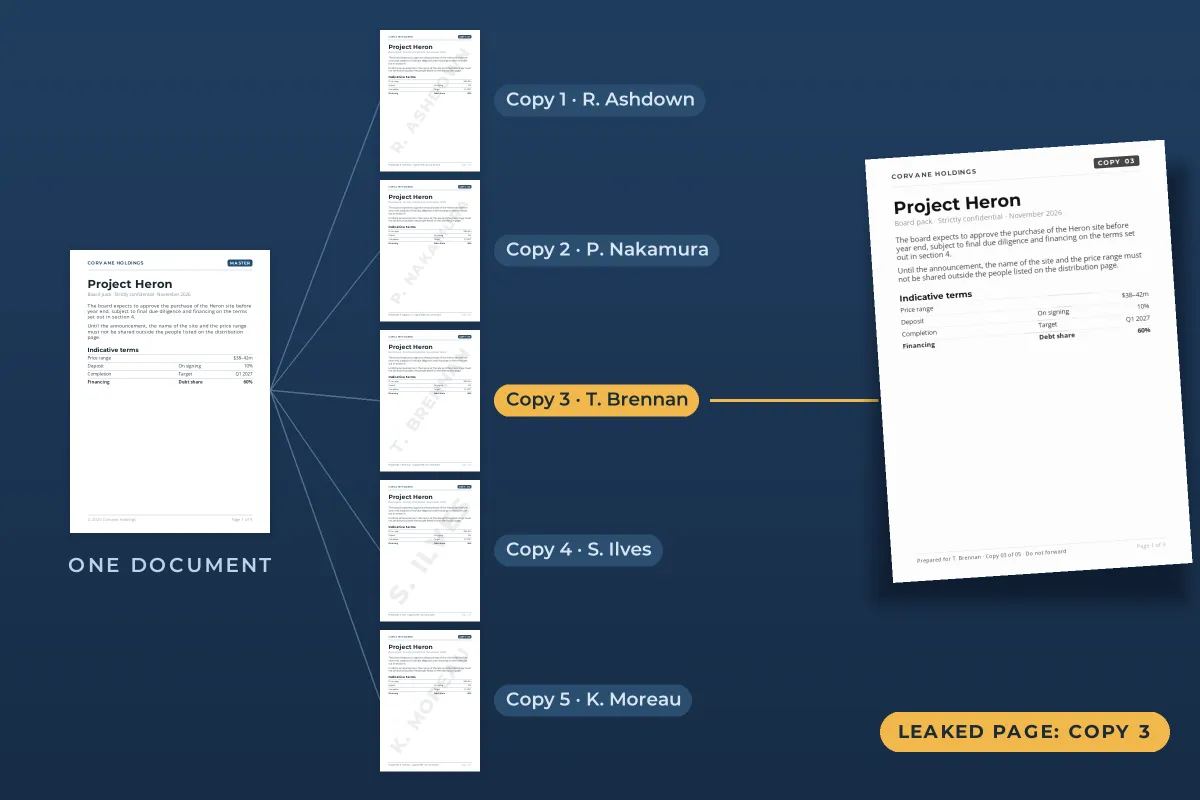
A traceable watermark is anything that is different in each copy of a document, so a leaked copy can be matched to the person who received it. It can be a visible name, a copy number, a small change in wording, or an identifier only special software can read. What makes it work is not the watermark itself but the record of which copy went to whom.
- Make every copy unique before it is sent. A leak cannot be traced if everyone received the same file.
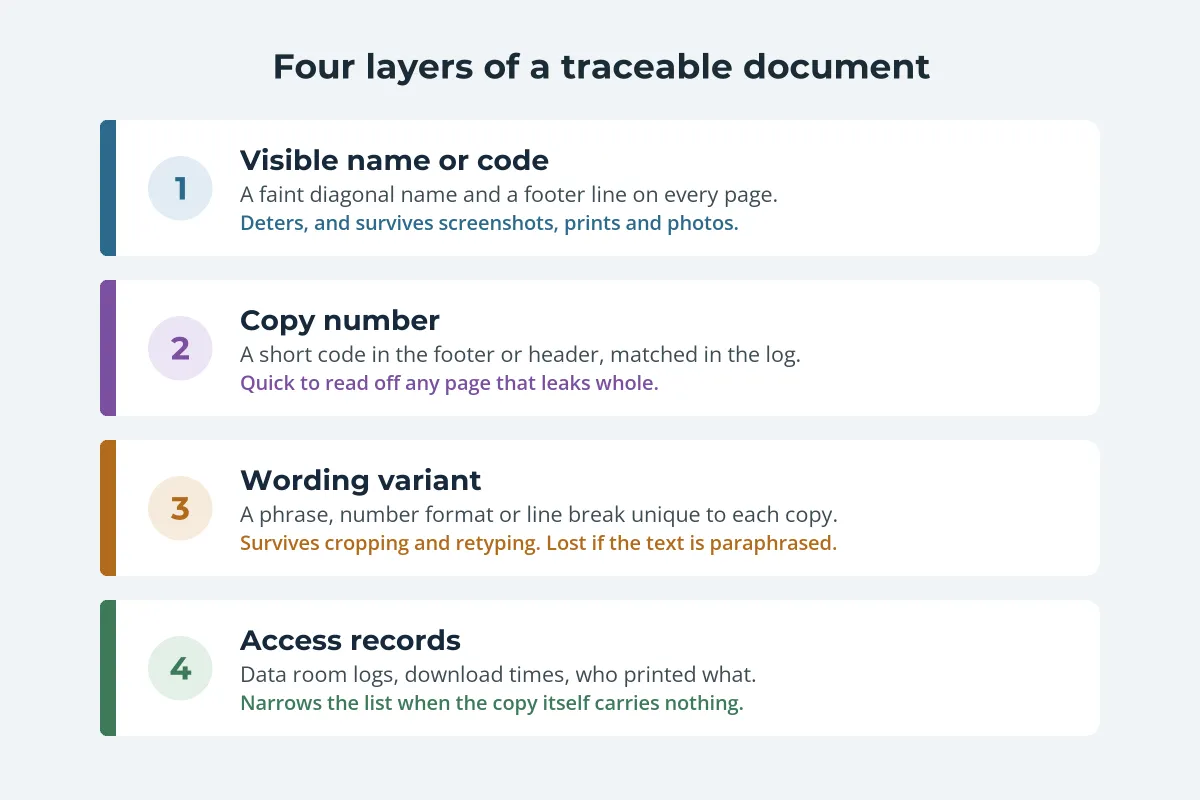
- Layer the watermarks: a visible name that deters and survives screenshots, plus a hidden variant that survives cropping and retyping.
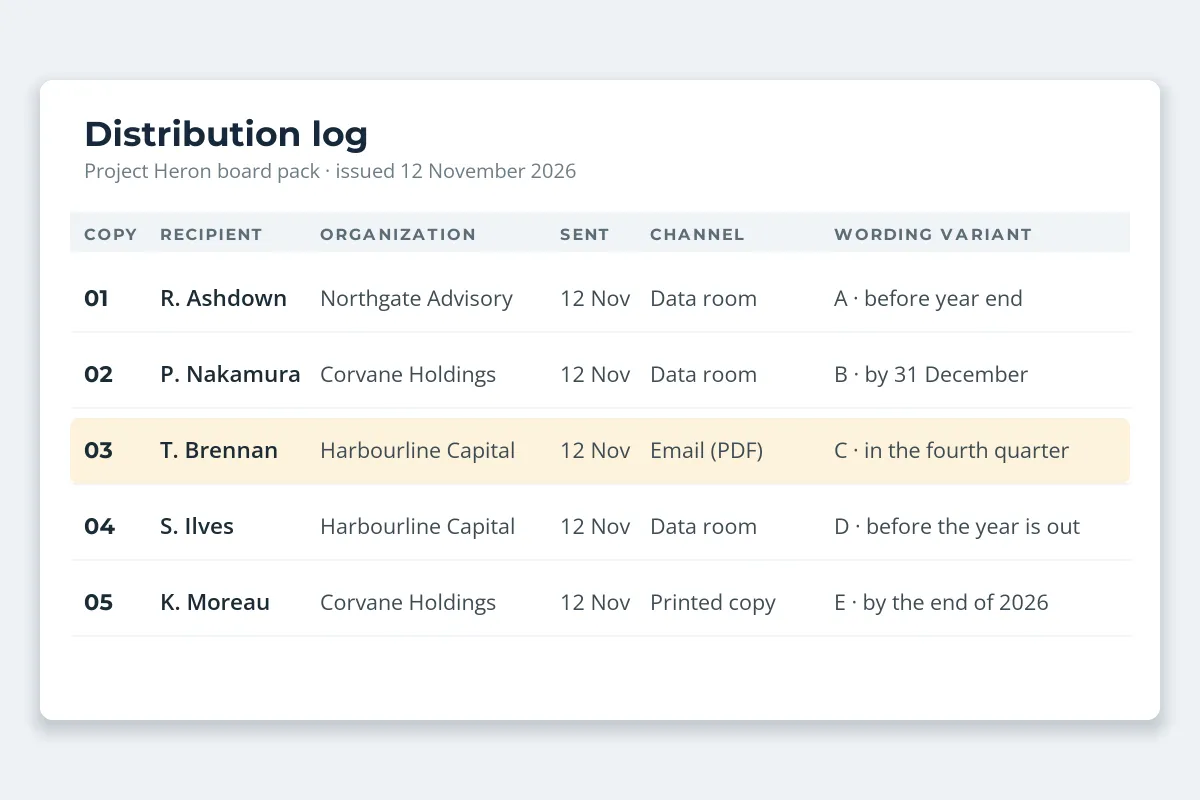
- Keep a distribution log of who got which copy, when and how. Without it, the watermarks mean nothing.
- Use a data room for the most sensitive material, so each page view is stamped and logged.
- Treat a match as evidence, not proof, and tell recipients up front that their copies are personalized.
If you only need a faint watermark or a name on a PDF, how to add an invisible watermark to a PDF compares the individual techniques. This article is about the process around them: planning a distribution so that tracing is possible, and doing the tracing when something leaks.
Step 1: Plan the Distribution Before Anything Goes Out
Most leak investigations fail at this step, long before the leak. Someone sends the same PDF to twelve people, it turns up in the press, and there is nothing to compare it against. Decide these things before the first copy goes out:
- Who gets a copy. Every extra recipient makes a leak more likely and a trace less precise. Send summaries to people who do not need the detail.
- Which layers each copy carries. A visible name for everyone; a wording variant for the most sensitive pages; a data room for material that should never leave it.
- How copies are numbered. A short copy number, such as 03 of 05, is easier to read off a damaged page than a full name.
- How each copy travels. Data room, email, printed and handed over. The channel affects what logs you will have later.
- Where the log lives, and who can see it. Keep it separate from the document, with restricted access.
Step 2: Put a Visible Name on Every Copy
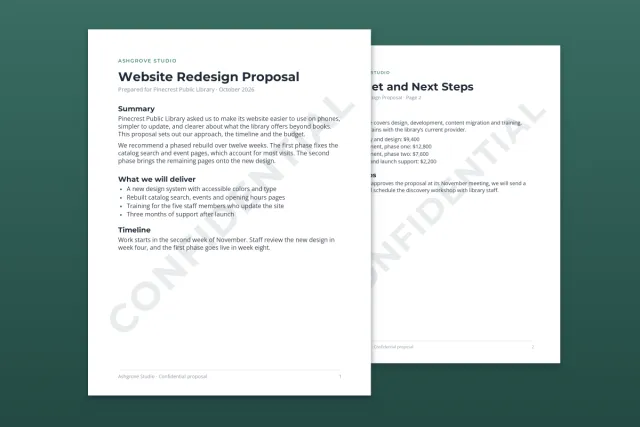
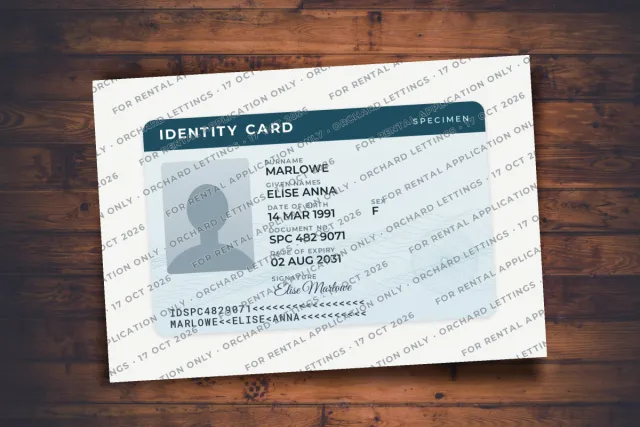
The most useful traceable watermark is one everybody can see: the recipient’s name as a faint diagonal watermark, and again in the footer with the copy number, for example "Prepared for T. Brennan · Copy 03 of 05 · Do not forward". It sits alongside the document’s classification label, covered in how to mark a document as confidential.
- It deters. People hesitate to forward a page with their own name across it. Most leaks that never happen are prevented here.
- It survives the usual leak routes. Screenshots, printouts, scans and photos of a screen all carry a visible watermark.
- It is quick to read. If a whole page leaks, the name or copy number answers the question in seconds.
Its weakness is that a determined leaker can crop it, cover it or retype the text. That is why the next layer exists. To make the visible watermark harder to crop, run it across the body of the page rather than only in a margin, as described in confidential and draft watermarks.
How to produce the copies depends on how many there are. A mail merge in Word can put each recipient’s name in the footer. In Watermark.ws, design the watermark once and save it as a template, then change only the name for each recipient’s copy; there is no automatic per-recipient variable text, so this suits a handful of copies rather than hundreds. The PDF watermarking guide walks through the editor. Data rooms, covered below, stamp each viewer automatically.
Step 3: Add a Hidden Variant (the Canary Trap)
A canary trap gives each recipient a version of the document with slightly different wording, so a leaked passage identifies its copy even when no name survives. The term was coined by Tom Clancy in his 1987 novel Patriot Games, but the technique is older: in his memoir Spycatcher, former MI5 officer Peter Wright described it as long-standing practice, under the name "barium meal".
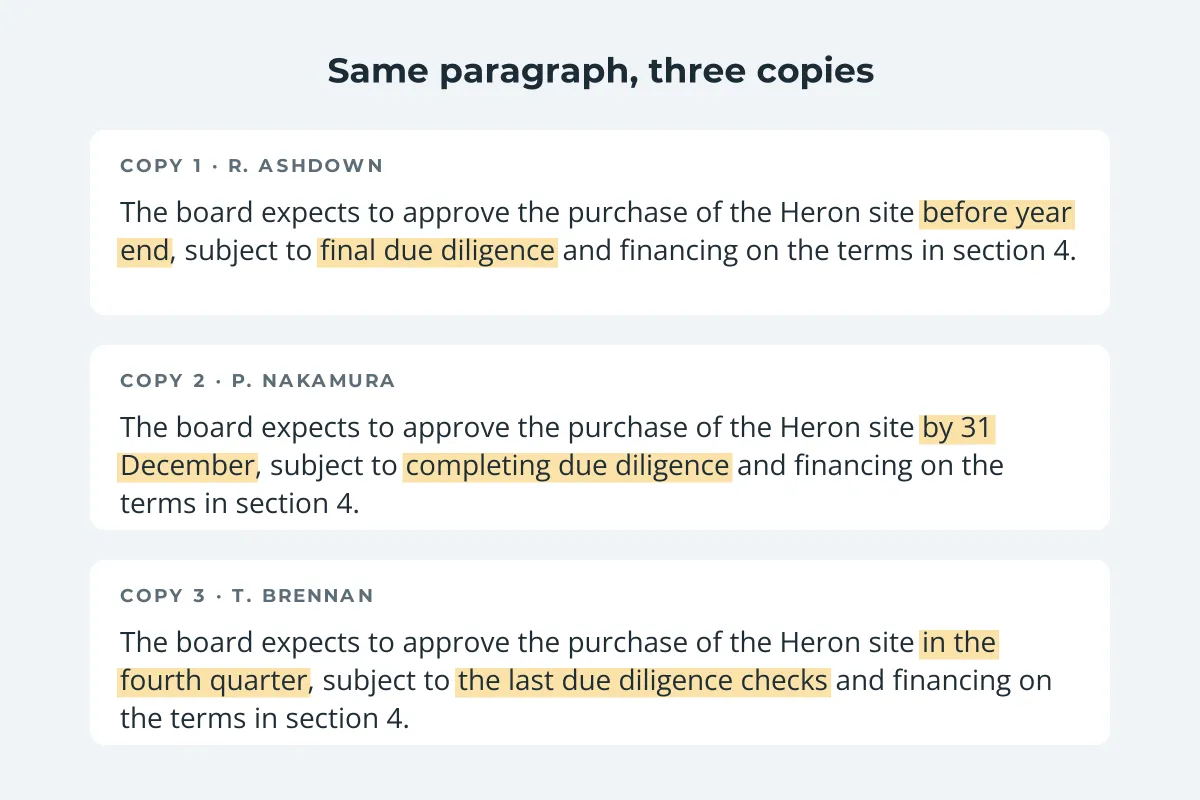
Good variants are changes nobody would notice or question:
- Synonyms and phrasing: "before year end", "by 31 December", "in the fourth quarter".
- Formatting of numbers and dates: "$40m" or "$40 million", "12 Nov" or "12 November".
- Punctuation and line breaks: an Oxford comma in one copy, a paragraph split in another.
- Images and tables: a chart cropped slightly differently, or rows in a different order where the order does not matter.
Never change facts, figures or terms anyone might rely on: a "variant" price is a misstatement. Put variants on several pages, so a leaked excerpt is likely to include one. Use combinations, so two recipients comparing their copies cannot easily spot and strip every difference. And record each variant in the log the moment you create it.
Data Rooms and Dynamic Watermarks
For deals, due diligence and board material, a virtual data room does much of this work automatically. Instead of sending files, you give people access to view them, and the data room records what each person does.
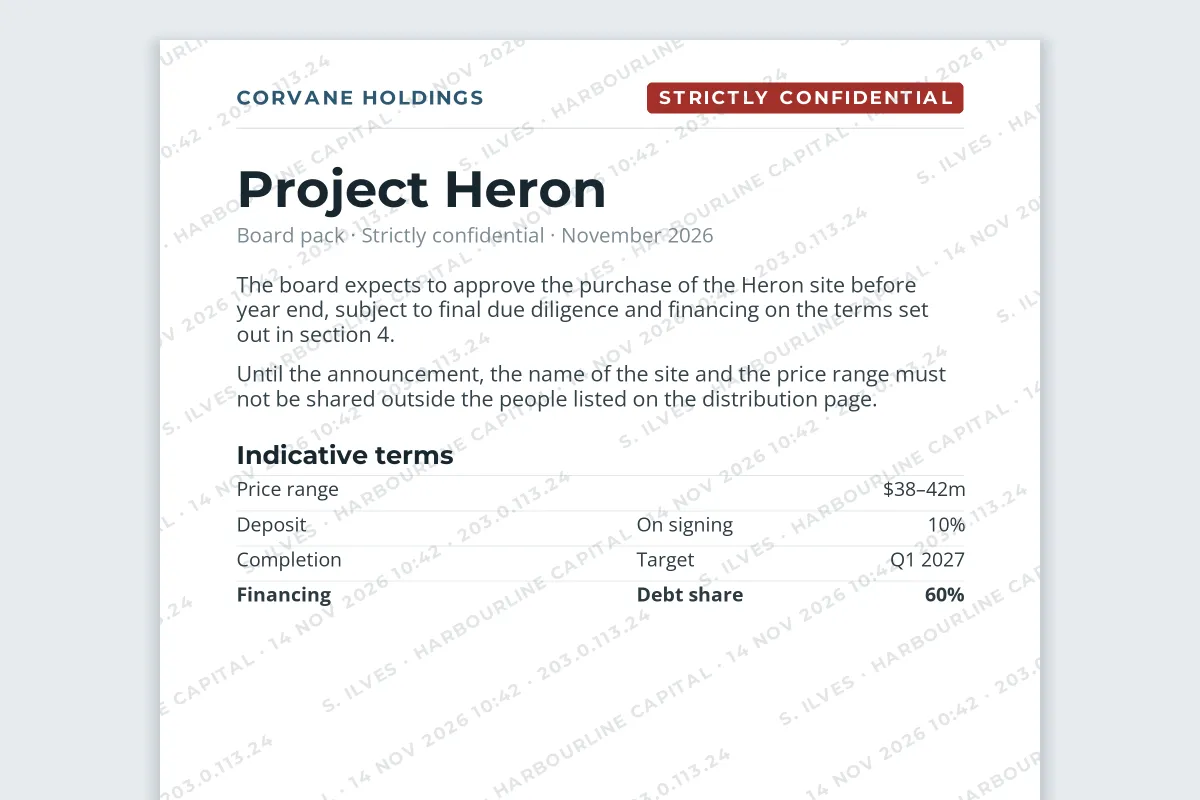
- Dynamic watermarks: many data rooms stamp each page with the viewer’s name or email, the date and time, and sometimes their IP address, at the moment it is viewed, printed or downloaded.
- Access logs: who opened which document, for how long, and whether they downloaded or printed it.
- Permissions: view-only access, no downloads, no printing, and access that can be withdrawn at any time.
None of this stops someone photographing a screen, but the stamp is in the photo, and the log shows who was looking at that page and when.
Forensic Watermarking, at a High Level
Forensic watermarks hide an identifier in the document itself, in changes too small to notice, such as tiny shifts in the spacing of lines or words, or patterns in the images on a page. Specialist software adds the watermark and a detector reads it back. Each method survives different things: some are built to survive printing and scanning, others are lost as soon as the text is retyped.
You may already produce forensic watermarks without knowing it. Many color laser printers add a faint pattern of yellow dots to every page that can identify the printer and the time of printing, a practice the Electronic Frontier Foundation documented by decoding one manufacturer’s pattern in 2005.
For most organizations, forensic watermarking makes sense only for very high-value material, through a data room or document security provider that offers it. Ask exactly which conversions the watermark survives: printing, scanning, screenshots, photos of a screen and retyping. For how the same ideas work on photos, see invisible watermarks and Content Credentials.
Step 4: When a Leak Appears, Trace It
-
Preserve what leaked
Save the leaked file, page or post exactly as found, with the address and the date. Do not crop or "clean up" your evidence.
-
Read the visible watermarks
Look for names, copy numbers and footer lines, including partial ones at the edges of a crop.
-
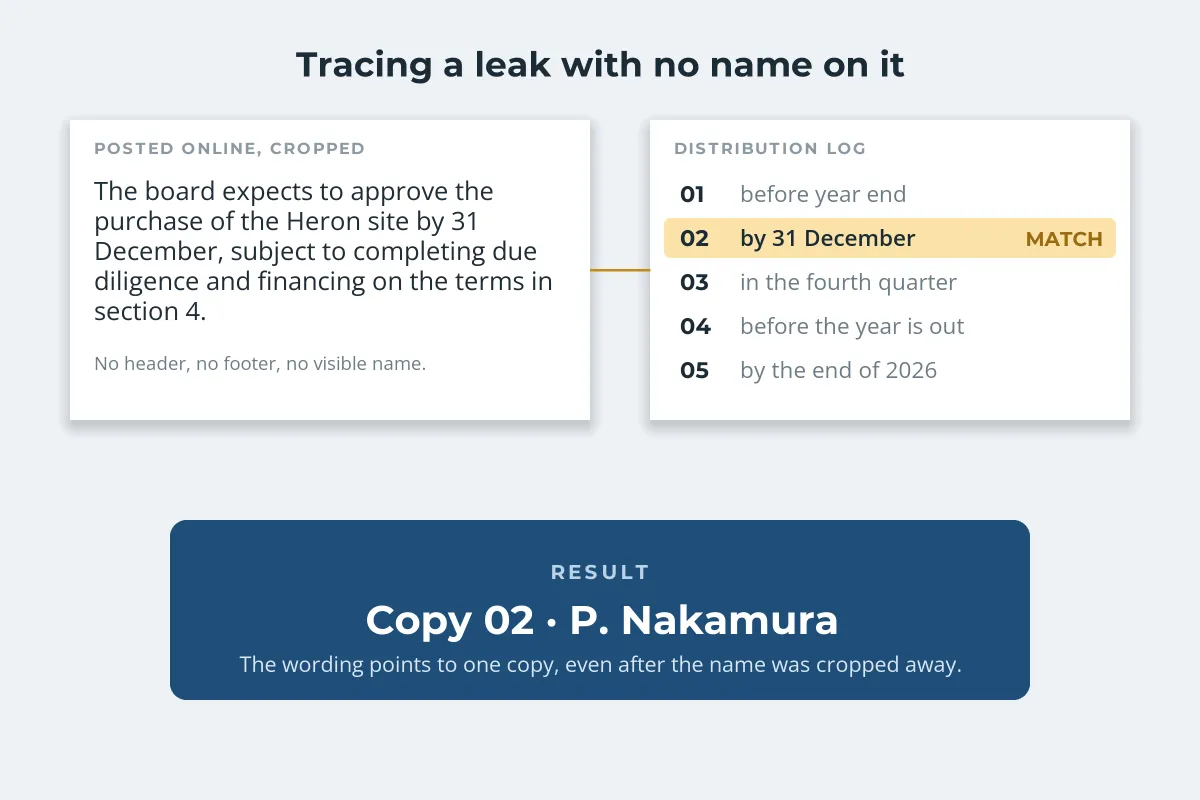
Compare the wording
Check the leaked text against the variants in your log. One distinctive phrase can be enough; two make the match much stronger.
-
Check the file and the logs
If the file itself leaked, look at its metadata. Check data room logs and email records for who accessed that version and when.
-
Decide what to do
Involve HR or legal advisers before confronting anyone, especially if employment or contracts are involved.
| How it leaked | Visible name | Copy number | Wording variant | Access logs |
|---|---|---|---|---|
| Whole file forwarded | Yes | Yes | Yes | Yes |
| Screenshot of a page | Usually | If in frame | Yes | Yes |
| Cropped excerpt | Often lost | Often lost | Yes | Yes |
| Photo of a screen | Yes | If in frame | Yes | Yes |
| Text retyped | No | No | Yes, if copied word for word | Yes |
| Content paraphrased | No | No | No | Yes |
Remember what a match shows: which copy the leak came from, not who leaked it. A recipient may have forwarded their copy to a colleague, left it on a shared printer or had their account compromised. And a canary trap only works once against a careful leaker, so the visible name, which deters in the first place, remains the most valuable layer.