On this page
How Long Does Photo Copyright Last? The Short Answer
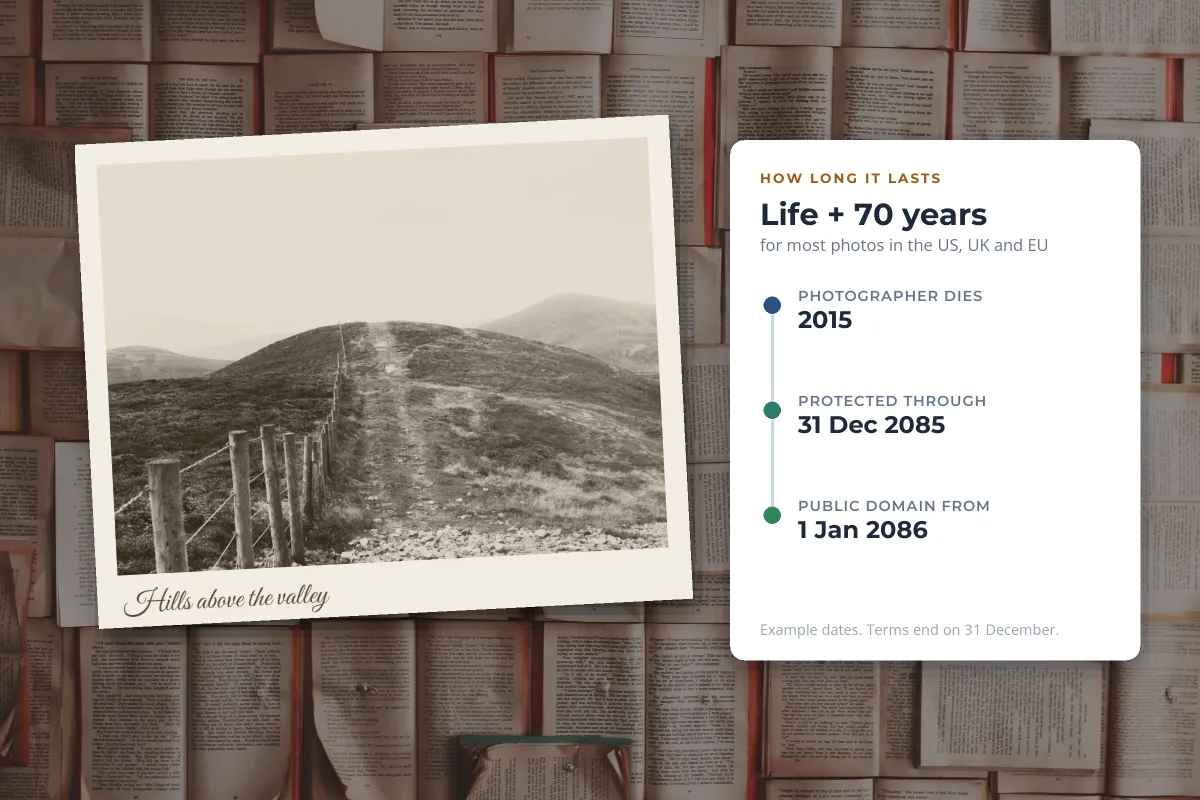
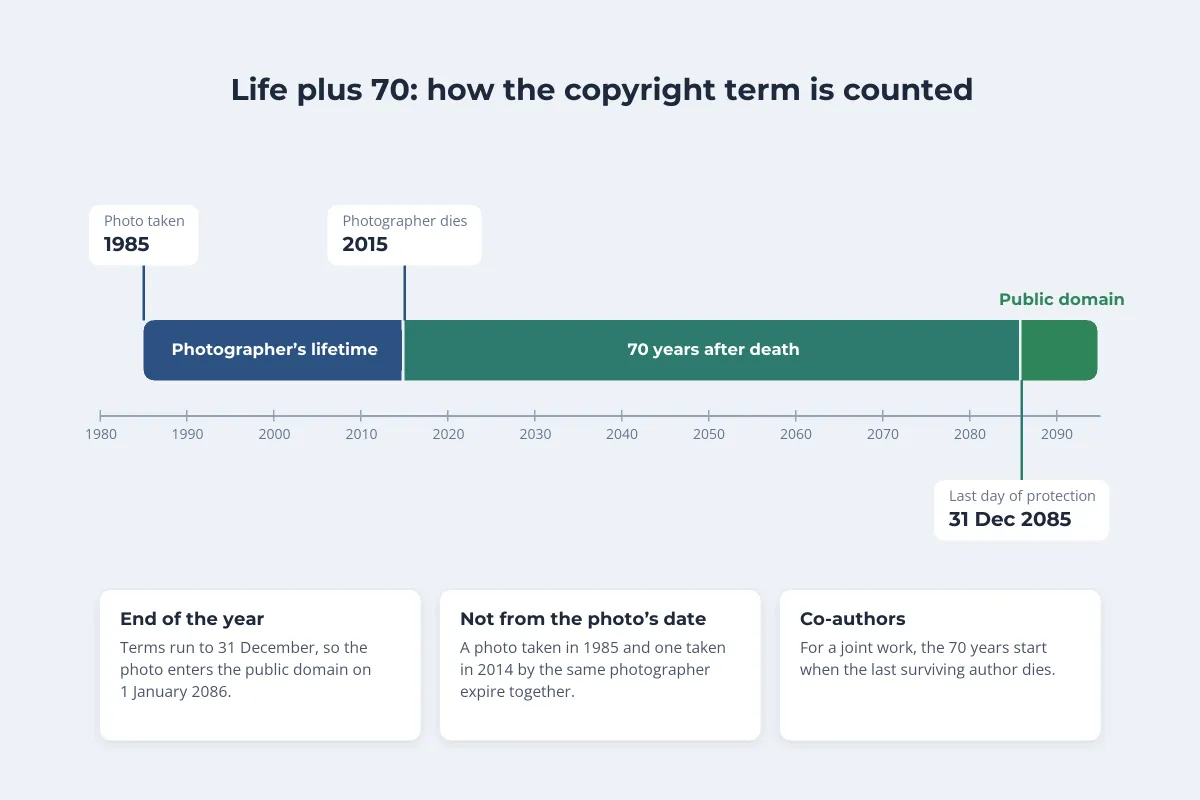
How long does photo copyright last? For a photo taken today, in the US, the UK, the EU and many other countries, the answer is the life of the photographer plus 70 years. The clock does not start when the photo is taken, but when the photographer dies, and it runs to the end of that calendar year.
- Most photos: the photographer’s life plus 70 years in the US, the UK and the EU.
- US works made for hire and anonymous photos: 95 years from publication or 120 years from creation, whichever ends first.
- Older US photos: anything first published in the US before 1931 is in the public domain in 2026. Photos from 1931 to 1977 depend on notices and renewals.
- Elsewhere: terms range from about 50 years after death to 100. Some EU countries also give plain, non-creative photos a shorter right.
Life Plus 70: The Standard Term
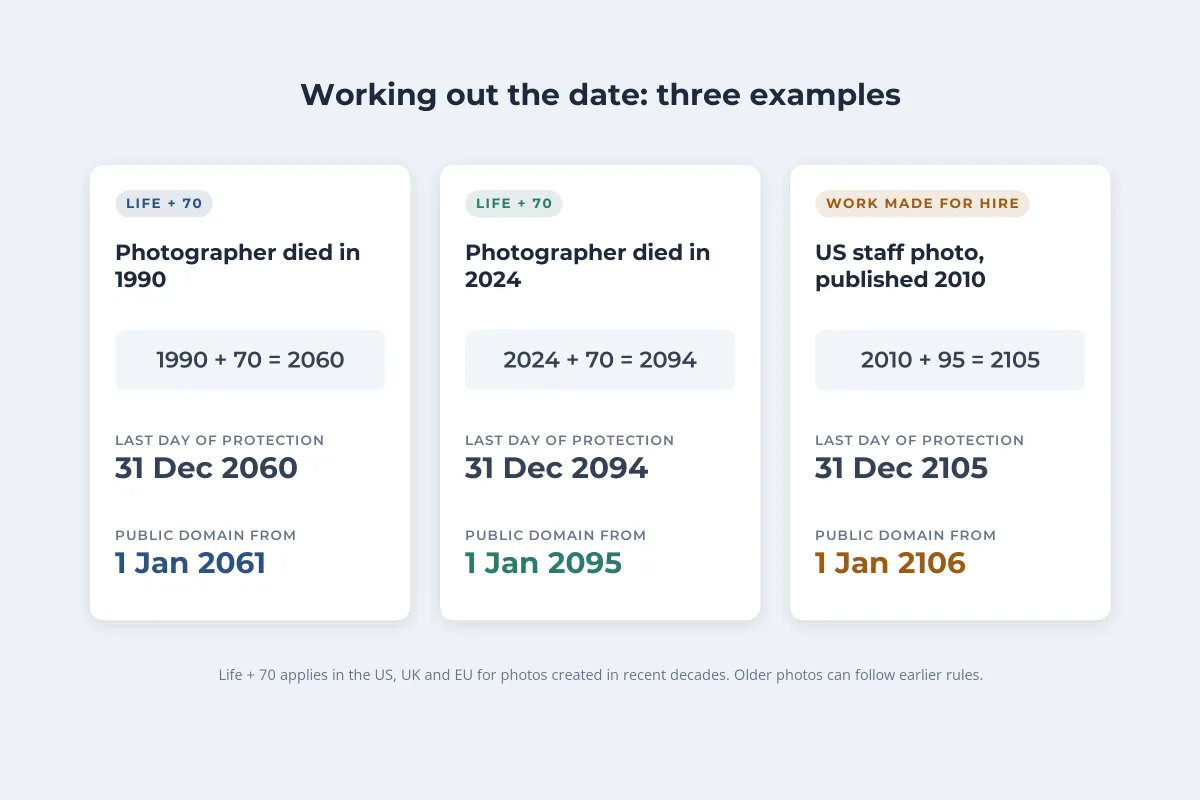
Life plus 70 is the rule in US law for works created since 1978 (17 U.S.C. § 302), in the UK (Copyright, Designs and Patents Act 1988, section 12) and across the EU (the Term Directive, 2006/116/EC). A few details shape how it works:
- It ends on 31 December. Terms run to the end of the calendar year, so every photo by a photographer who died in 2015 enters the public domain on 1 January 2086.
- Every photo by the same photographer expires together. A photo taken at 20 and one taken at 80 share the same end date.
- Joint works run from the last death. When two people are both authors, the 70 years start when the last of them dies.
- Registration, notices and watermarks do not change it. A © line or a watermark does not extend the term, and leaving it off does not shorten it. Does a watermark count as copyright? explains what a watermark does add.
- Copyright is inherited. After the photographer dies, the copyright passes to their heirs or whoever they left it to, who can license it and enforce it for the rest of the term.
Works Made for Hire and Anonymous Photos in the US
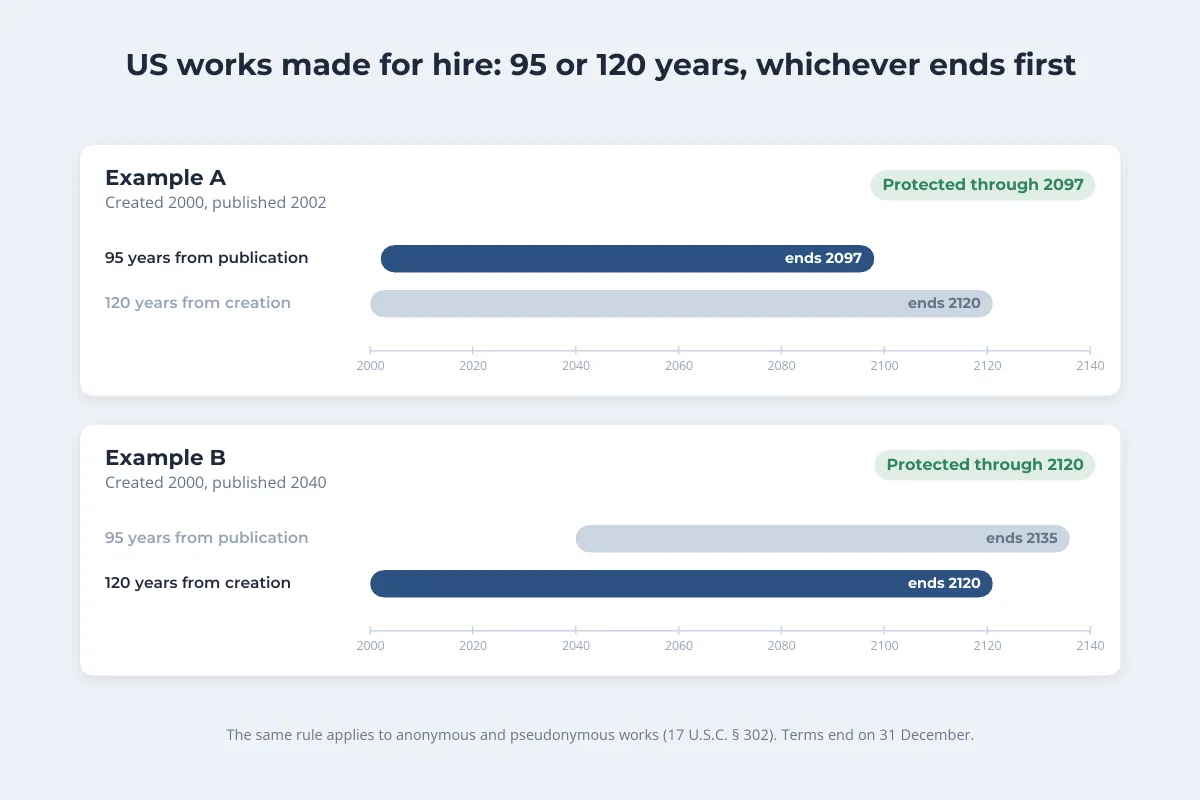
When a company owns a photo as a work made for hire, for example because a staff photographer took it as part of the job, there is no individual lifetime to measure. US law uses fixed terms instead: 95 years from first publication or 120 years from creation, whichever expires first. The same rule applies to anonymous and pseudonymous photos.
The UK and the EU have no separate term for employers. A photo an employee takes is usually owned by the employer, but it still lasts for the photographer’s life plus 70 years. For a photo whose photographer is unknown, the UK and EU term is 70 years from when it was made, or from when it was first made available to the public. Who owns a photo in the first place is a separate question, covered in who owns the photos, photographer or client.
Older Photos and the US Public Domain
Before 1978, US copyright ran from publication, not from the photographer’s death, and it came with formalities: a notice on published copies and, for many years, a renewal filing. Those rules still decide the status of older photos today.
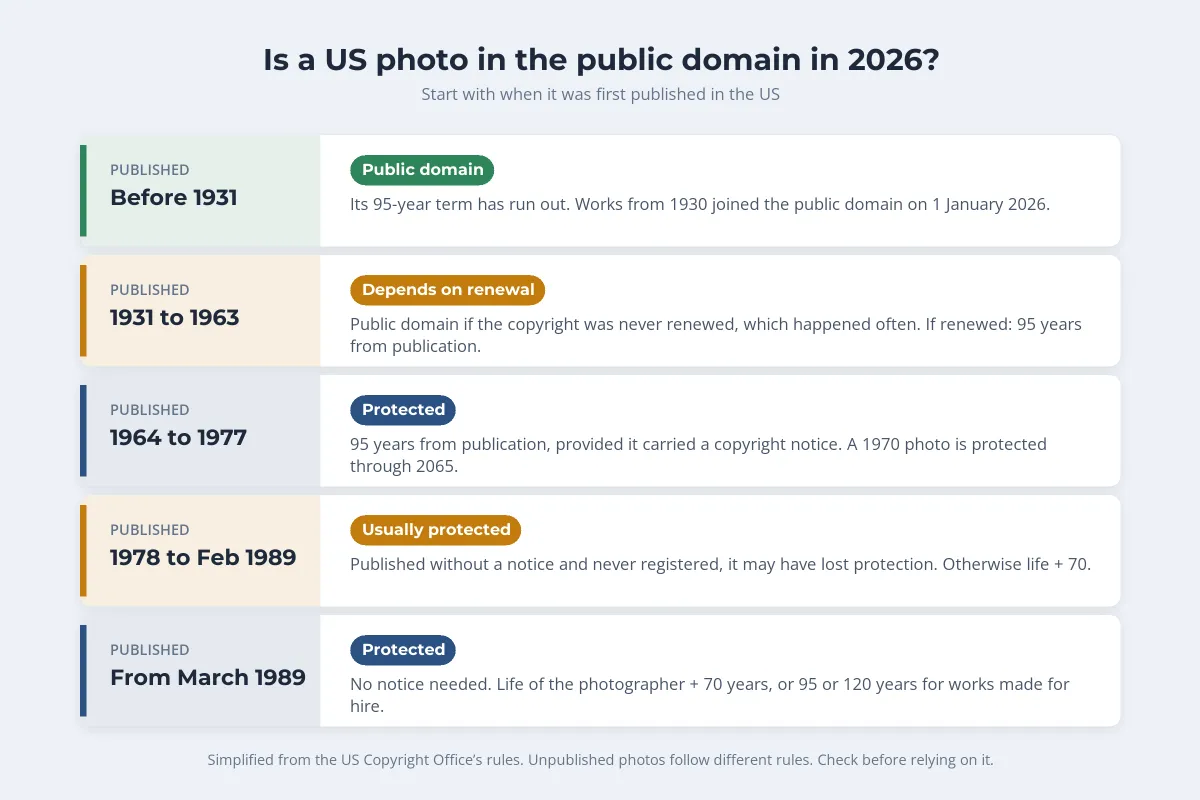
- Published before 1931: in the public domain. Photos published in 1930 joined it on 1 January 2026, and each new year adds another year’s worth.
- Published 1931 to 1963: protected for 95 years only if the copyright was renewed in its 28th year. Many were never renewed, so many of these photos are in the public domain. The Copyright Office’s records show whether a renewal was filed.
- Published 1964 to 1977: renewal became automatic, so a photo published with a notice is protected for 95 years from publication.
- Published 1978 to 1 March 1989: the notice was still required, but a missing one could be fixed by registering within five years.
- Since 1 March 1989: no notice is needed, and the life plus 70 or work-for-hire terms apply.
Photos that were never published follow different rules, and a photo first published abroad may have had its US copyright restored. When the answer matters, the Copyright Office’s Circular 15A on duration and a search of its records are the place to check.
Photo Copyright Duration by Country
| Country | Term for most photos | Notes |
|---|---|---|
| United States | Life + 70 | Works made for hire and anonymous works: 95 years from publication or 120 from creation. Pre-1978 photos follow publication-date rules. |
| United Kingdom | Life + 70 | Unknown photographer: 70 years from creation or from when the photo was made available. Older photos follow transitional rules. |
| European Union | Life + 70 | Harmonized by the Term Directive. Some countries also protect non-original photos for shorter terms. |
| Canada | Life + 70 | Extended from life + 50 on 30 December 2022, without reviving works that had already expired. |
| Australia | Life + 70 | Older photos follow the rules that applied when they were taken. |
| Japan | Life + 70 | Extended from life + 50 in December 2018. |
| China | Life + 50 | Since the 2021 amendment. Previously 50 years from first publication. |
| India | 60 years | Counted from the year after the photo was first published. |
| Mexico | Life + 100 | One of the longest terms in the world. |
Within the EU, life plus 70 applies to photographic works, meaning photos original enough to reflect the photographer’s own creative choices. Several countries add a separate, shorter right for photos that fall below that line, such as a plain record shot.
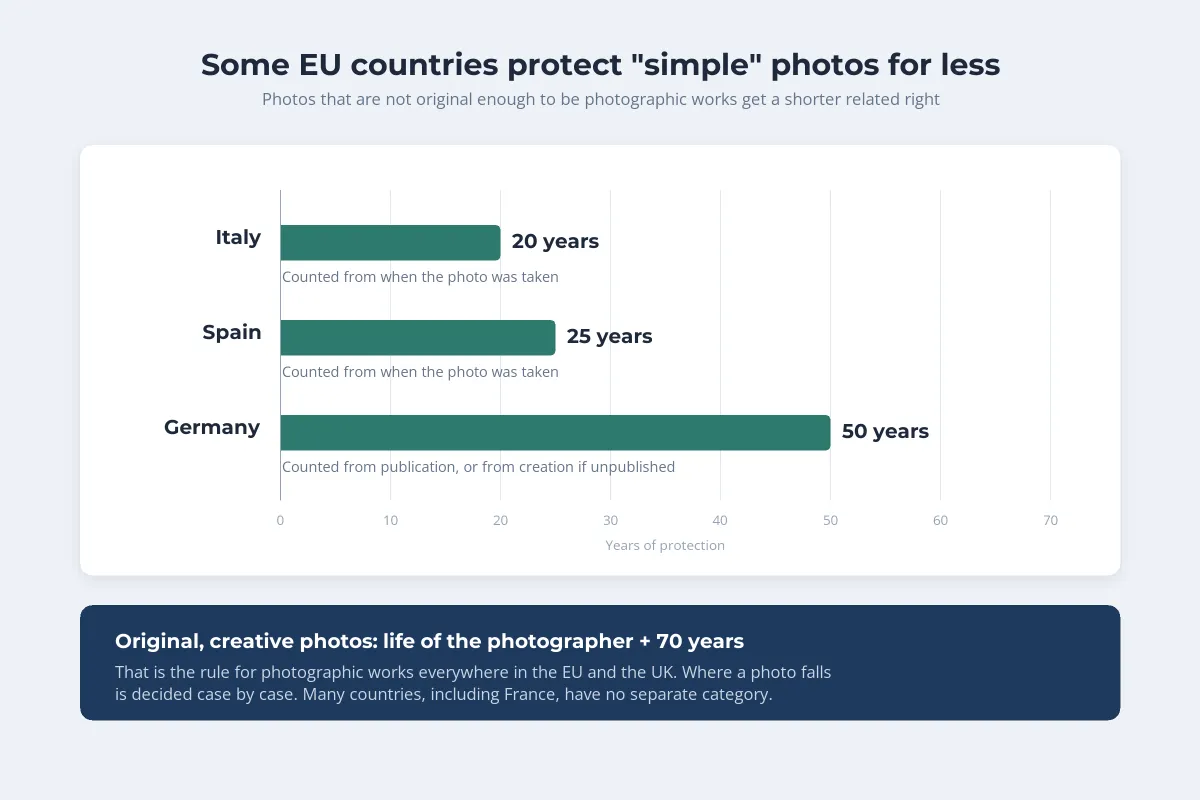
Terms are only part of the picture. For how infringement, damages and registration differ, see copyright laws by country.
What Public Domain Means, and What It Doesn’t
Once copyright expires, anyone may copy, adapt and sell the photo without permission. A few things can still get in the way:
- The term depends on the country. A photo can be in the public domain in the US and still protected in Europe, or the other way around. What counts is where you use it.
- Scans do not restart the clock, mostly. Since the EU’s 2019 copyright directive, a faithful reproduction of a public domain work of visual art gets no new copyright of its own. US courts reached a similar result for exact copies of public domain artworks in Bridgeman v. Corel (1999). A museum may still set terms for downloading from its website.
- People and trademarks are separate. An expired copyright does not clear privacy, publicity or trademark rights in what the photo shows.
- CC0 is not the same as expiry. Some photographers waive their rights early with CC0, which puts a photo as close to the public domain as the law allows. See Creative Commons licenses explained.
If you are not sure whether an image is still protected, treat it as protected. Can I use images from Google? walks through checking an image before you use it, and how to check if an image is copyrighted covers metadata and Copyright Office records.
What It Means for Your Own Photos
Your photos are protected from the moment you take them, for as long as you live and for 70 years after, in most of the world. You do not need to do anything to get that term. What you can do is make it easier to enforce:
- Put your name on the photos you share. A notice or a watermark does not lengthen copyright, but it tells people who owns it. The year in a © notice is the year of first publication, not an expiry date. See how to write a copyright notice.
- Register what matters, if you are in the US, so statutory damages are available if someone copies it.
- Leave instructions. Your copyrights pass to your heirs. Saying who gets them, and where the originals and records are, makes them far easier to manage.
Watermark.ws adds a © line, your name or your logo to whole batches of photos, PDFs and videos in the browser, and saves it as a template for next time.
Sample photos: Wall of book pages by Patrick Tomasso, Path over the hills by Sylwia Bartyzel on Unsplash.