
On this page
- The Short Version
- Step 1: Make Sure It Really Is Infringement
- Step 2: Save the Evidence Before You Contact Anyone
- Step 3: Gather Proof That the Photo Is Yours
- Step 4: Decide What You Actually Want
- Step 5: Ask Directly, in Writing
- Step 6: Report It to the Platform or Host
- Step 7: When It Is Worth Getting Legal Help
- Make the Next Theft Less Likely — and Easier to Fix
The Short Version
The first instinct is to fire off an angry comment. Resist it. A public argument tips off the other person, who may delete the post before you have proof it ever existed — and it rarely gets the photo taken down faster than the quiet route.
- Check it really is infringement — not a license you, an agency or a client already granted.
- Save the evidence before you contact anyone.
- Decide what you want: credit, removal, or payment.
- Ask the person or business directly, politely and in writing.
- Report it to the platform or web host if they ignore you.
- Talk to a lawyer only when there is real money or repeated commercial use involved.
This guide describes common, practical steps. Copyright law differs from country to country, and the right approach for a specific case can depend on details. If significant money is involved, speak to a lawyer who handles copyright in your country.
Step 1: Make Sure It Really Is Infringement
It is embarrassing — and it weakens your position — to accuse someone who turns out to have permission. Before you do anything else, run through the ways they might be allowed to use it:
- Did you license it? Check old emails, invoices and contracts, including usage rights you gave clients. A client's marketing agency may be using it legitimately.
- Did an agency license it? If the photo is with a stock agency, the user may have bought a license through them.
- Did you publish it under an open license? If you once posted it under a Creative Commons license, people can use it on those terms — and those licenses cannot be withdrawn. See Creative Commons licenses explained.
- Could it be an exception? Some uses, such as commentary or criticism, can be lawful without permission. In the US this is fair use; see fair use and photos for what it does and does not cover.
If none of these apply — someone has simply taken your photo and is using it on their site, shop or feed — move on to collecting evidence.
Step 2: Save the Evidence Before You Contact Anyone
The moment you contact someone, the page may change or vanish. Capture it first, while it is still exactly as you found it.
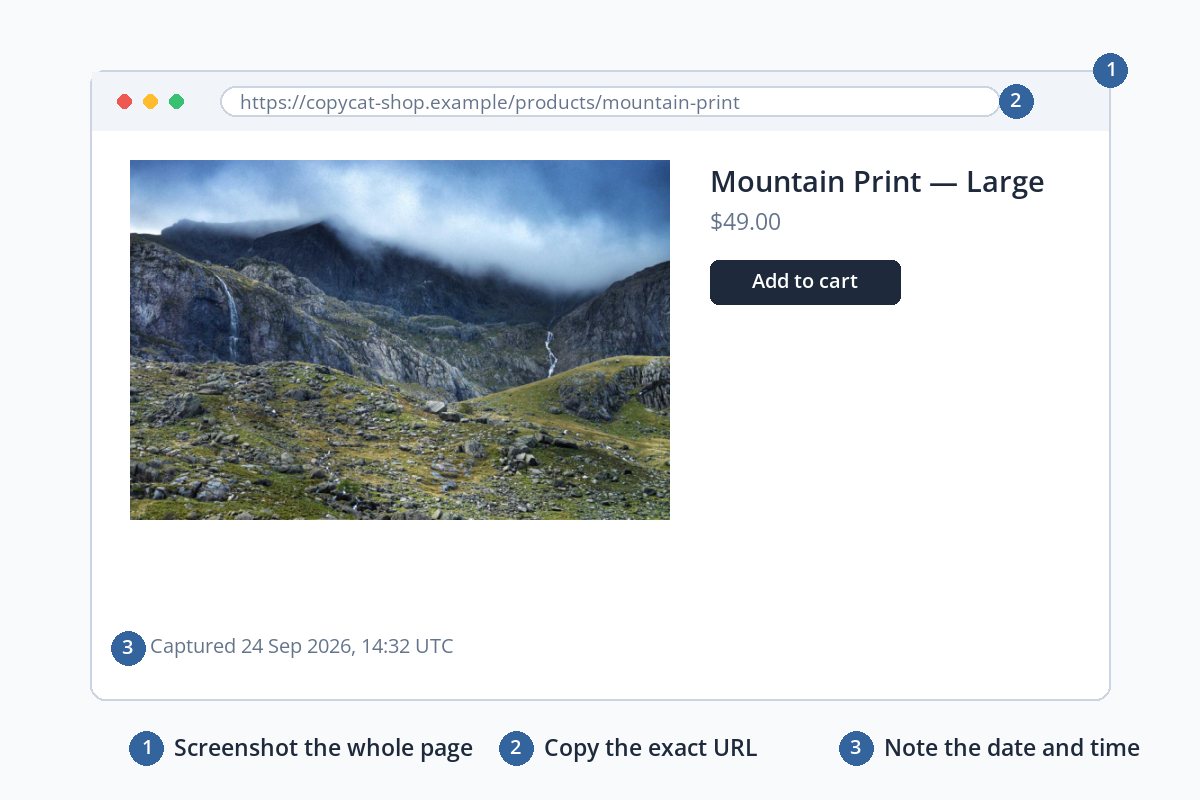
- A full-page screenshot that shows your photo in context — the product listing, the post, the article — not just the image.
- The exact URL of the page and, if you can, of the image file itself.
- The date and time you found it.
- Who is behind it: the account name, business name, seller ID or website owner, as shown on the page.
- An independent copy of the page. A public web archive such as the Internet Archive's Wayback Machine can save a snapshot that you do not control, which is useful if the page disappears later.
One spreadsheet row per copy: URL, date found, who, what you did, and when. If you end up reporting the same account twice, or talking to a lawyer, this log saves hours.
Step 3: Gather Proof That the Photo Is Yours
In almost every country, you own the copyright in your photo from the moment you take it. The US Copyright Office puts it plainly: copyright exists from the moment a work is created and fixed in a tangible form. What you need now is to be able to show that it is yours.
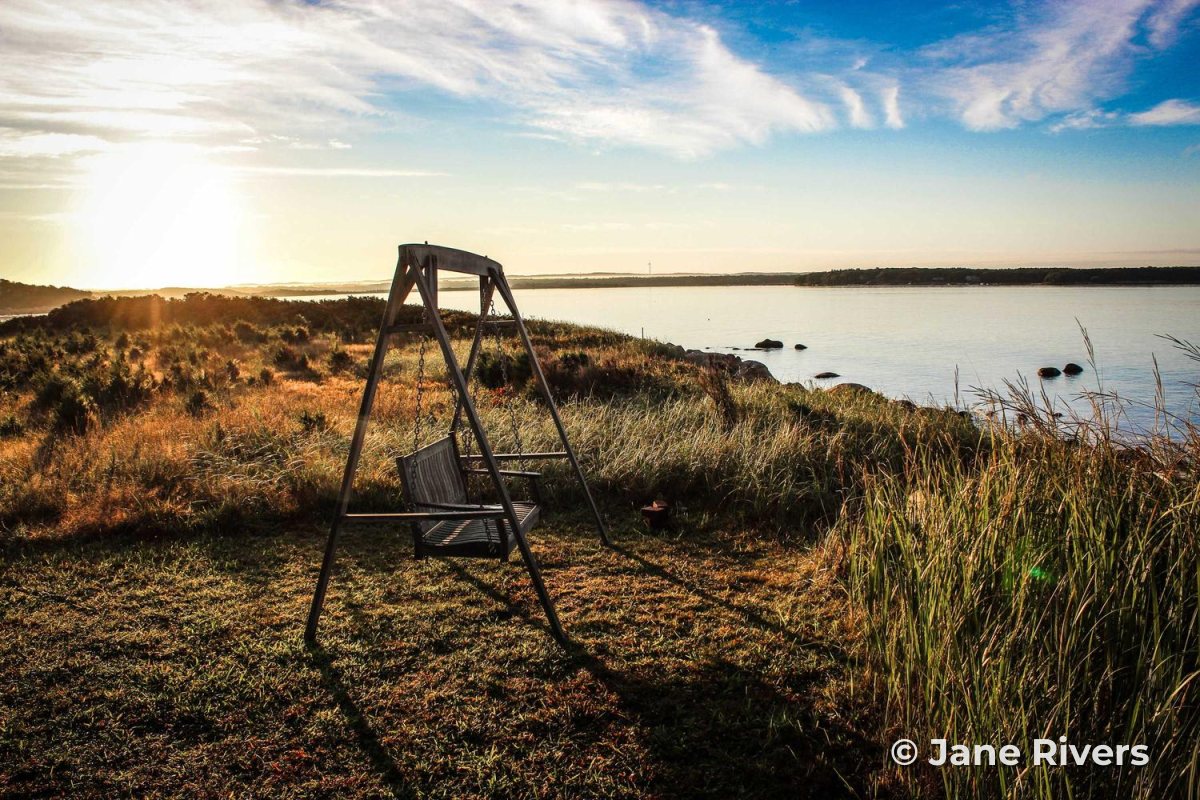
Copies found online are usually smaller, compressed and often cropped — like the one above, where the corner watermark has been trimmed away. Your originals are not. That difference is strong evidence:
- The full-resolution original, and ideally the camera RAW file.
- Other frames from the same shoot — the shots before and after are very hard for anyone else to have.
- Your earliest publication — the date it went up on your site, portfolio or social account.
- Any registration, if you have registered the photo. In the US this matters a lot for what you can recover; see should you register copyright on your photos?
Step 4: Decide What You Actually Want
Your next message depends on the outcome you are after. Be honest with yourself about it — it decides how much time this is worth.
| You want… | Usually works best | Good for |
|---|---|---|
| Credit | A friendly request to add your name and a link. | Bloggers, fans and small accounts who did not know better. |
| Removal | A request, then a platform report or takedown notice. | Accounts that ignore you, or anyone you do not want associated with your work. |
| Payment | An invoice for a retroactive license, at your normal rate. | Businesses using your photo to sell or advertise. |
| It to stop for good | A takedown, then legal advice if it keeps happening. | Repeat or large-scale commercial copying. |
Plenty of photographers turn infringers into clients. A business that liked your photo enough to take it may be happy to pay for it once asked — and a retroactive license resolves things faster than any dispute.
Step 5: Ask Directly, in Writing
Many people who use a photo without permission genuinely assumed anything online was free to use. A short, factual message resolves a surprising number of cases. Keep it calm and specific:
-
1
Say which photo, and where
Link to the page and describe the image, so there is no doubt what you mean.
-
2
Say it is yours
State that you took the photo and did not give them permission to use it.
-
3
Say what you want
Credit, removal by a date, or payment of a license fee — with the amount and how to pay.
-
4
Set a reasonable deadline
A week is common. Say what you will do next if you do not hear back — for example, report the page to the platform.
-
5
Keep a copy
Use email or the platform's messaging, and add the message to your log.
Avoid threats you do not intend to carry out, and do not overstate what the law entitles you to. A calm message is more credible, and it reads better if anyone else ever sees it.
Step 6: Report It to the Platform or Host
If they ignore you, or you would rather not deal with them at all, go over their heads. Social networks, marketplaces and web hosts all have copyright reporting forms, because the law in many countries gives them a reason to act on them.
- Social networks and marketplaces: look for "report" → "intellectual property" or "copyright" on the post or listing. Marketplaces often run dedicated rights-owner programs.
- Websites: find out who hosts the site and send the host a takedown notice. In the US this follows the notice-and-takedown process in the DMCA; see how to file a DMCA takedown notice.
- Outside the US: most countries have their own rules, and many hosts accept notices from anywhere. See copyright infringement laws by country.
Takedown notices are made under penalty of legal consequences in many systems. Only report photos you own the rights to, and only uses you have not allowed.
Step 7: When It Is Worth Getting Legal Help
For a blog post or a small account, a takedown is usually the end of it. It is worth speaking to a copyright lawyer when:
- A business is making money from your photo — on products, ads or packaging.
- The same person or company keeps doing it after takedowns.
- Your photo was used in a way that damages your reputation or your existing licensing deals.
In the US, two things are worth knowing before that conversation. First, according to the Copyright Office, you have to register a US work before you can bring an infringement lawsuit, and registered works may be eligible for statutory damages and attorney's fees. Second, there is a small-claims option: the Copyright Claims Board handles disputes up to $30,000 in total, you do not need a lawyer, and you need a registration or a pending application to file. Participation is voluntary, so the other side can opt out.
Make the Next Theft Less Likely — and Easier to Fix
- Watermark the photos you share, over part of the subject rather than in a corner.
- Share web-sized copies and keep full-resolution files for clients.
- Search for your best photos regularly — see how to find stolen photos.
- Keep your originals, RAW files and earliest publication dates organized.
- Put a clear copyright notice on your site — see how to write one.
- Argue publicly before you have saved the evidence.
- Accuse someone before checking your own licenses.
- Make threats you will not follow through on.
- Rely on a corner watermark alone — one crop removes it.
- Report uses you actually agreed to.
A visible watermark will not stop every copy, but it changes the odds: casual copiers move on to an easier photo, and any copy that does spread still carries your name. For how to make one hard to remove, see can watermarks be removed? and where to put a watermark. Watermark.ws can add a watermark and resize a whole batch for the web in one pass.
Sample photos: Tablet by timothy muza, Mountain valley by James Pritchett, Swing at sunrise by Jon Eckert on Unsplash.