
On this page
Does a Watermark Count as Copyright? The Short Answer
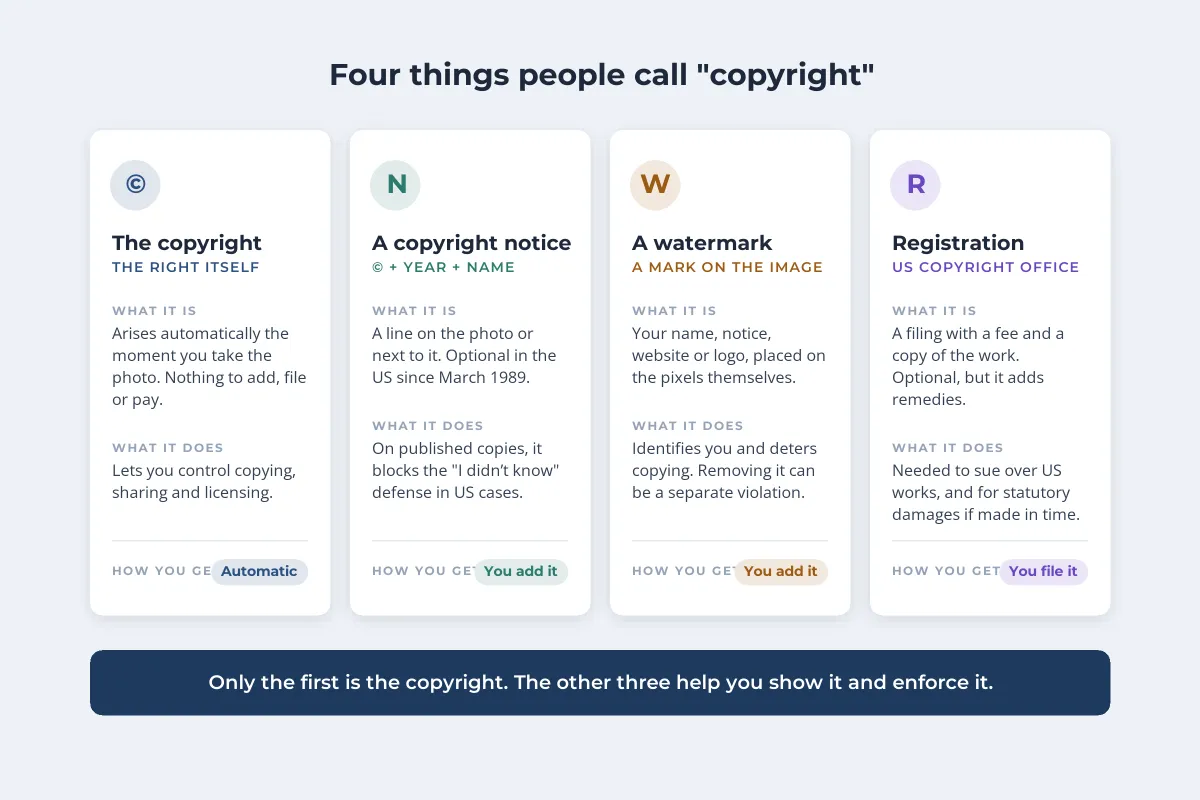
Does a watermark count as copyright? No. Copyright is a legal right that exists automatically when you create a photo. A watermark is text or a logo you place on the image. It does not create the copyright, and removing it does not take the copyright away. What a watermark can do is announce your ownership, and that has real legal and practical value.
- No watermark is needed. In the US, the UK, the EU and most other countries, copyright arises the moment a photo is taken.
- A watermark is a notice, not the right. It tells people who owns the photo and how to reach them.
- In the US it can add legal weight. A proper © notice on published copies blocks the innocent infringer defense, and removing a watermark that names you can be a separate violation under 17 U.S.C. § 1202.
- It does not replace registration. To sue over a US work and claim statutory damages, you still need to register.
Copyright Exists Without a Watermark
The Berne Convention, which most countries have joined, forbids making copyright depend on formalities. In the US, a notice stopped being required for works published from March 1, 1989. Since then, a photo with no watermark, no © line and no registration is fully protected.
 No watermark
 Watermarked
Legally, both photos are equally protected. The difference is what a stranger knows when they find one. The clean photo gives no clue who owns it; the watermarked one says it outright. That is why the old excuse "it didn’t have a watermark, so I thought it was free" has no legal basis, but still gets used. Anyone unsure about a photo can check whether an image is copyrighted before using it. For how long that protection lasts, see how long photo copyright lasts.
What a Watermark Adds
If copyright is automatic, why do photographers bother? Because a watermark does several jobs that the bare right cannot:
- It identifies you. Anyone who wants to license the photo, or credit it, knows who to ask.
- It deters casual copying. Many people skip a photo that clearly belongs to someone, and a watermark across the subject makes the photo much less useful to take.
- It travels with the image. Captions and metadata get stripped by platforms and screenshots. A watermark in the pixels stays until someone deliberately removes it.
- It supports a claim. A copy carrying your watermark is strong evidence of where it came from, and its removal is evidence of intent.
A Watermark as a Copyright Notice
In the US, a watermark that is also a correct copyright notice gives you one specific legal advantage. Under 17 U.S.C. § 401(d), if a proper notice appears on the published copies an infringer had access to, the court gives no weight to a defense of innocent infringement in mitigating damages. Without that, a defendant who convinces the court they had no reason to know they were infringing can see statutory damages cut to as little as $200.
A proper notice has three parts (§ 401(b)): the © symbol, the word "Copyright" or "Copr."; the year of first publication; and the owner’s name. Compare three common watermarks:



If you want the legal benefit, use the full form, such as "© 2026 Cora Whitfield". Whether a given watermark satisfies the notice rules is ultimately for a court to decide, but a complete notice in a visible spot gives you the best footing. For the wording, the year and where to put it, see how to write a copyright notice, and for the shortcuts on each device, how to type the copyright symbol.
Removing a Watermark Can Be a Separate Violation
The Digital Millennium Copyright Act protects "copyright management information", or CMI, which includes the author’s name, the owner’s name, the information in a copyright notice, terms of use, and identifying numbers or links conveyed with a work (17 U.S.C. § 1202(c)). A watermark that carries any of these can count.

- Removing it: intentionally removing or altering CMI, knowing or having reasonable grounds to know that it will help enable or conceal infringement, is a violation (§ 1202(b)). So is distributing copies knowing the CMI was removed.
- Faking it: knowingly adding false CMI, such as putting your own name on someone else’s photo, with intent to enable or conceal infringement, is also a violation (§ 1202(a)).
- The remedy: statutory damages of $2,500 to $25,000 per violation (§ 1203), separate from any damages for the copying itself.
- Courts apply it to visible credits. In Murphy v. Millennium Radio Group (2011), a federal appeals court held that a photographer’s printed credit could count as CMI, even though it was not part of an automated system.
The knowledge requirement matters: an accidental crop is not the same as scrubbing a name to pass a photo off. For what removal looks like in practice and how to make it harder, see can watermarks be removed.
Outside the US
- No formalities anywhere in the Berne system. In the UK and the EU, as in the US, a watermark is never what makes a photo protected.
- Rights management information. The EU’s 2001 Copyright Directive (Article 7) and the UK’s Copyright, Designs and Patents Act (section 296ZG) protect electronic rights management information against knowing removal. How far that reaches a visible watermark in an image has been tested less than the US rule.
- No innocent infringer rule of the US kind, but a clear notice still helps. Damages often depend on what the infringer knew, and a name on the image makes "I had no idea" hard to argue.
- Moral rights. In the UK and EU, photographers generally have a right to be identified as the author. A watermark is one practical way to make sure they are.
For penalties and procedures country by country, see copyright laws by country.
What a Watermark Does Not Do
| Watermark | Copyright notice | US registration | Metadata | |
|---|---|---|---|---|
| Creates copyright | No | No | No | No |
| Identifies the owner on sight | Yes | Yes, if next to the image | No | No, it is hidden |
| Survives screenshots | Yes | Only if on the image | Not applicable | No |
| Blocks innocent infringer defense (US) | If it is a full notice | Yes | No | No |
| Protected under § 1202 (US) | Yes, if it carries CMI | Yes | Not applicable | Yes |
| Needed to sue for statutory damages (US) | No | No | Yes, made in time | No |
A watermark also does not extend your copyright, prove you are the original author on its own, or protect a logo as a trademark. Anyone can type a name onto a photo, which is why your original files and the camera’s data matter if ownership is ever disputed. Registration is covered in should you register your photo copyright.
Making Your Watermark Count
- Use the full form: © year and your name.
- Put it where a simple crop will not remove it.
- Add your website or a licensing link if you want inquiries.
- Keep the same watermark on every copy you publish.
- Keep your original, unwatermarked files and register important work.
- Treat the watermark as a substitute for registration.
- Use a nickname nobody can trace back to you.
- Put the watermark only in the metadata, where platforms strip it.
- Add someone else’s name or a fake notice.
- Assume a clean, unmarked photo online is free to use.
Watermark.ws lets you type a © notice, choose a font, place it on photos, PDFs, GIFs or videos, and save it as a template so every batch carries the same notice. It adds visible watermarks only; it does not write metadata or hidden ones.
Sample photos: Mountains at night by Martin Staněk, Misty lake by Dustin Scarpitti, Forest valley by Eutah Mizushima, Breaking wave by Tim Marshall on Unsplash.